
horrible ping latency though
When my cousin learned about Ping at school in the 2000s he setup
ping gateway -ton all the computers in his highschool class.Took down the school network for the day. He didn’t get in trouble I think. Just a laugh from the school admin (they knew each other and he volunteered there). Admin blocked ping after that.
I was in HS from 2001 to 2005, and it was the wild west. They had computer money galore, but the guys tasked with being in charge of them knew as much as we did, and they just could not compete with the teenage ingenuity. I remember using telnet to just shoot the shit with people all day, and eventually play MUDs in class. And trying to destroy the computer or the network from the inside was just a daily occurrence.
Man they really need to check for loops in the network, that sounds like a feedback loop. Although my experience only goes back to like 2012 so it might have been a older hardware thing
I mean a easier and sinister solution would be to unplug two computers and patch the two ports together. Broadcast storm.
What was the rate of packets sent? Modern
pingis typicallysetuided and has a limit of 1 per second if you’re not root.I believe it was multiple threads…

*since 1983.
digging through man pages makes you realize that most of the stuff that makes the modern internet consists of one-man projects glued together.
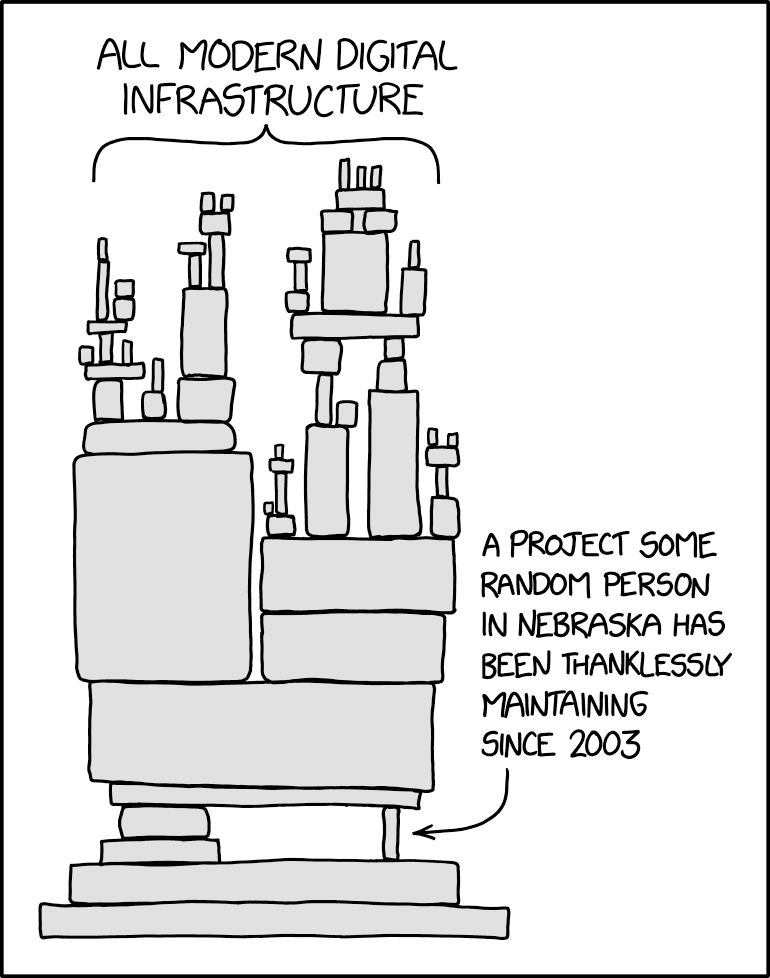
It’s also when the scope of those projects could be accomplished by one person.
Maybe we should go back to the roots and start doing things well, instead of just glueing more and more together. Maybe even start with hardware and kernels made for desktop use.
The original idea behind Unix was to have small tools doing very specific task and do it will.
Then you could use shell to combine them together to do more advanced stuff.
Even if projects could be solo efforts, it’s probably better to avoid the bus factor.
Even worse than bus factor, it’s really easy to compromise when no one double checks your work:
What’s your BGB Plan? (Big Green Bus, I guess you could alter for the colour of buses in your city)
And many of those one men were Dave Plummer
deleted by creator
First thing you do to debug connectivity to a remote host problem is the ol’ ping.
This reminded me of a funny story in a party years ago. There was a Mac playing music on YouTube but after a couple of minutes the connection were lost and the music stop until someone clicked on something and the connection wake up and the music continue for a couple of more minutes just to go down again. I asked if I could try to fix it and the first thing I did was a ping, the first couple of packages got lost but then it connected and the music continued. Every couple of minutes some packages got lost but then it back again and the music didn’t had any more problems for the night. The host of the party was all over me thanking me for saving the party and other people were asking me if I was a hacker or something.
That person was Mike Muuss, who tragically died in a car crash in 2000, only 42 years old.
I love it when the TILs read like “I discovered my toes and they’re called toes”.
I learned about pings in college, because apparently my torrent client was constantly sending them, but the university network did not allow pings and they sent an email threatening to shut off my internet if I didn’t stop pinging.
Vasili. One ping only.

"PING! The magic duck!Using deft allegory, the authors have provided an insightful and intuitive explanation of one of Unix’s most venerable networking utilities.
Even more stunning is that they were clearly working with a very early beta of the program, as their book first appeared in 1933, years (decades!) before the operating system and network infrastructure were finalized.
The book describes networking in terms even a child could understand, choosing to anthropomorphize the underlying packet structure. The ping packet is described as a duck, who, with other packets (more ducks), spends a certain period of time on the host machine (the wise-eyed boat).
At the same time each day (I suspect this is scheduled under cron), the little packets (ducks) exit the host (boat) by way of a bridge (a bridge). From the bridge, the packets travel onto the internet (here embodied by the Yangtze River).
The title character — er, packet, is called Ping. Ping meanders around the river before being received by another host (another boat). He spends a brief time on the other boat, but eventually returns to his original host machine (the wise-eyed boat) somewhat the worse for wear.
If you need a good, high-level overview of the ping utility, this is the book. I can’t recommend it for most managers, as the technical aspects may be too overwhelming and the basic concepts too daunting.
As good as it is, The Story About Ping is not without its faults. There is no index, and though the ping(8) man pages cover the command line options well enough, some review of them seems to be in order. Likewise, in a book solely about Ping, I would have expected a more detailed overview of the ICMP packet structure.
But even with these problems, The Story About Ping has earned a place on my bookshelf, right between Stevens’ Advanced Programming in the Unix Environment, and my dog-eared copy of Dante’s seminal work on MS Windows, Inferno.
Who can read that passage on the Windows API (“Obscure, profound it was, and nebulous, So that by fixing on its depths my sight — Nothing whatever I discerned therein.”), without shaking their head with deep understanding. But I digress."
This review was so good I had to see if it was a real book! It is: The story about Ping.
Bravo, the world needs more reviews like this.
Bravo.
At work we say “i pung it”
Because pinged doesn’t sound right. And pung is more fun.
Another one we haven’t named yet is when an address goes through translation. Is it NATted? “Its been NATted”
Doesn’t feel right.
Oh so ‘NUT’ is not work appropriate language? Take it up with the author of NAT and with linguists
you’ll need to do better than this. maybe you’ll stumble on the right term in a moment of post-NAT clarity.
It was also backronym’d to mean Packet Internet Groper, but I get why not a lot of people would want to embrace that
I’ve never heard that before and I was better for it.
time to grope me some internet real quick. Just grabbing those packets and going all in
Well it goes along with the ethos of other commands suck as touch, finger, mount,…
ACK
Ping?
Pong
!
In a cli type “ping 8.8.8.8”
command not found: inI’m surprised your system doesn’t have that command, why is that?
The joke is that they wrote the entire comment on the terminal, and the command ‘in’ from ‘in a terminal’ doesn’t exist
Thanks.
Pong