
You must log in or # to comment.
My favorite is StalinSort. You go through the list and eliminate all elements which are not in line.
Reminds me of quantum-bogosort: randomize the list; check if it is sorted. If it is, you’re done; otherwise, destroy this universe.
Guaranteed to sort the list in nearly instantaneous time and with absolutely no downsides that are capable of objecting.
You still have to check that it’s sorted, which is O(n).
We’ll also assume that destroying the universe takes constant time.
In the universe where the list is sorted, it doesn’t actually matter how long the destruction takes!
It actually takes a few trillion years but its fine because we just stop considering the “failed” universes because they will be gone soon™ anyway.
Eh, trillion is a constant
What library are you using for that?
is-sorted and a handful of about 300 other npm packages. Cloning the repo and installing takes about 16 hours but after that you’re pretty much good for the rest of eternity
that explains why it took god 7 days to make the universe
We still suffer from the runtime errors that could’ve been caught at compilation time.
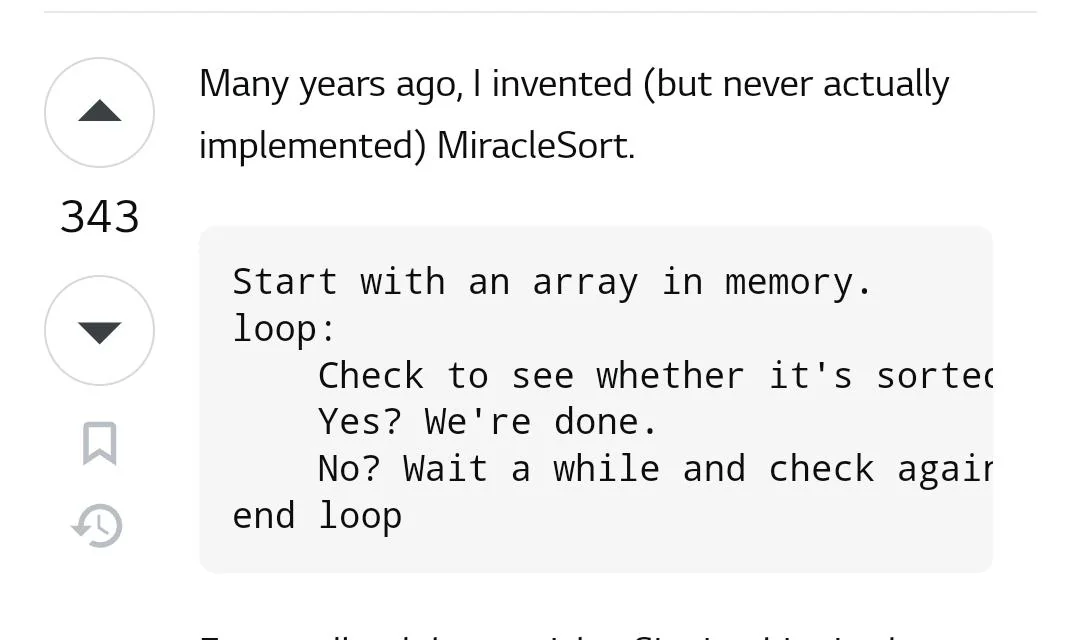
The most beautiful thing about this program is that it would work.
Various bit flips will once lead to all numbers being in the correct order. No guarantee the numbers will be the same, though…
Not necessarily. I don’t have the numbers in front if me, but there is actually a probability that, past that point, something is so unlikely that you can consider it to be impossible (I.e. will never happen within the lifetime of the universe)
deleted by creator
And the time complexity is only O(1)
I don’t think you can check if array of n elements is sorted in O(1), if you skip the check though and just assume it is sorted now (have faith), then the time would be constant, depending on how long you’re willing to wait until the miracle happens. As long as MTM (Mean Time to Miracle) is constant, the faithfull miracle sort has O(1) time complexity, even if MTM is infinite. Faithless miracle sort has at best the complexity of the algorithm that checks if the array is sorted.
Technically you can to down to O(0) if you assume all array are always sorted.