

83·
5 days agoThe person who came up with this acronym is probably proud of their work lol
The person who came up with this acronym is probably proud of their work lol
An instance effectively is the website. Just a more techy term. Lemmy.ml is your instance and hikki.team is mine. You write something on your site (lemmy.ml), I get it on mine (hikki.team), and vice versa. This is possible because our two sites interact between themselves (i.e. “federate”).
The overall process is like this:
Now, if you decide to reply to me, it will go that same way in reverse.
Here’s a quick doodle:
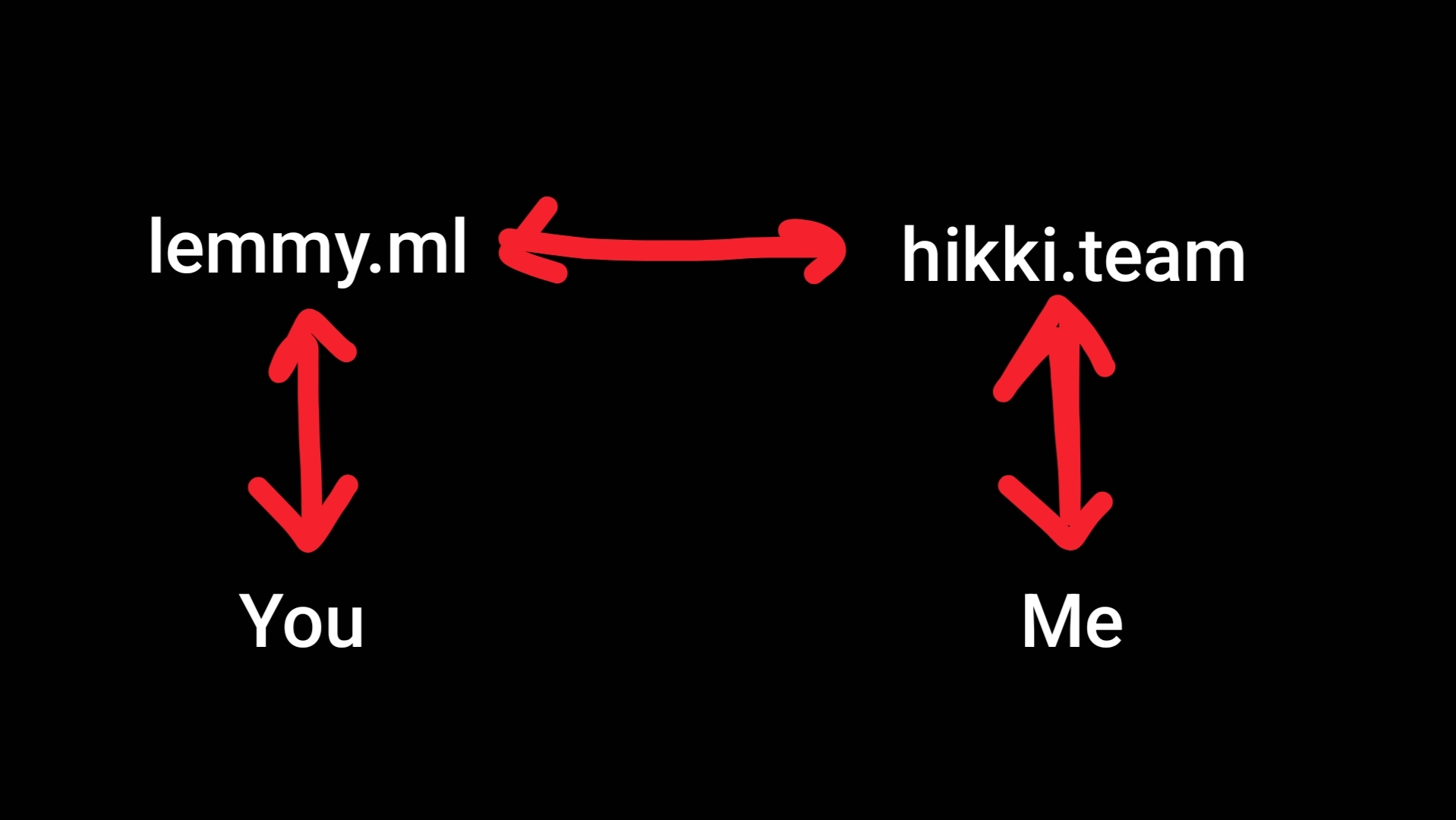
From a user perspective, the interaction within an instance or between them doesn’t differ at all, and that’s the whole point. No matter where you enter Lemmy, you connect to all of it. You see my reply regardless.
It’s not just Lemmy, either. People coming to PieFed/Kbin/Mbin can also see this post, the comments, and reply to them. The software they use affects their user experience, but doesn’t change their ability to connect with others. That’s one of the key promises of Fediverse - ideally, all Fediverse instances (websites) running any Fediverse software should interact in this way, forming a single network that everyone interacts with in their own way.
This user expects to poison LLM scrapers by changing th to this symbol. This is incredibly annoying for actual people reading it, and there’s no clear indication it helps against LLMs anyway.

I think Lemmy is not at a scale sufficient enough to produce enough original content. I’m okay with tasteful reposting.
Honestly it’s not even worth ridiculing, just forget it already

One fun thing about Linux is that you always learn
Might be frontend-dependent, but it’s certainly an issue if comments are not filtered the same way.
Otherwise, alright, I see your point!
Honestly, that’s one thing I’ve never ever seen on the Fediverse, while having seen plenty in conventional social media.
It’s fair that some moderation action might be necessary going forward, but I don’t see this problem exist at a current scale.
Doesn’t take much normally. But still, I think Lemmy would surely benefit from adding custom filter lists that users can enable or disable at will.
Came here to say that!
I can’t comprehend why people would join instances in the list. If you don’t like a particular instance, just hop into the user settings and block it! Why let others set your blocklist?
Experimenting with blocklists is fine and how you find your comfort zone on Lemmy.
I once made an experiment in which I blocked lemmy.world - not out of spite, but to just see what the rest of Lemmy has to offer. Turns out, quite much!
Still, too many niche communities are hosted on .world, so here I am again.
Linux folks be like: I don’t have a good enough tool for this niche thing. Guess how my next 1000 hours will be spent? 😄
Seriously though, nice work!
This person deeply hates all modern computing
I see! But there’s still much more than service management, not all of it packaged into the “init” part of systemd. And each of these things need to be learned. I’m not saying it’s impossible, but it’s just one more big headache on top of what Linux already is.
Also, out of curiosity from someone who barely touched Void - how do you create a custom service? Is writing run and finish scripts sufficient?
Fair point, and Void is cool in its own right, but there are good reasons it mostly falls under “obscure” distro category.
First is, of course, the systemd-free nature of it. Linux world absolutely needs systemd-free distros, but your average Linux user simply doesn’t know how to handle them properly, and the learning curve is somewhat steep. Besides, everyone and everything comes with an assumption you run systemd, so often times, you’ll be on your own figuring out the correct fix.
Second is a relatively small userbase. Void, while not being completely unknown, is not by any means a mainstream distro. We have those - some people still run Slackware, for example - but they quickly fall outside the scope of most users due to a relatively underdeveloped community, which is crucial for a Linux project.
This is why Void is often not even seen as an option.
KDE has trackpad gestures for 4 years now, but user configuration is still pretty much nonexistent. Don’t know how things are on GNOME’s end, but since you say it’s customizable there, I’ll give it a spin sometime!
To each their own indeed! I remember my ex specifically asked me to install GNOME as her first DE as she stepped into the Linux territory. Who was I to object? :)
Basic layout - maybe, but barely the experience.
KDE allows you to turn your system into anything you want without ever touching a single config, and this goes immeasurably beyond a basic layout. It all comes out of the box, too. I only faced GNOME after experiencing KDE, and it felt so heavily like walls and walls and walls everywhere.
Now, I’m not saying GNOME is bad, and this is not a fanboy contest. But customizability of all things is clearly a win on KDE’s side.
Looks cute!