

1·
30 days agoDepends, index alone (no trackers, no controllers) is Quite a bit cheaper
Depends, index alone (no trackers, no controllers) is Quite a bit cheaper
I personally expect that they will want to cover hardware cost, while being willing to subsidize development cost with the steam store.
So I think the low storage models will make a slight loss for valve in the beginning, while the higher storage models will get that back to even overall for valve.
The most disappointing part is the rumoured pricing of “aiming to be under $1000”.
$1 is “under $1000”.
at $999, even for the 1TB model, this is a really tough sell.
I’m not sure I’d get one, even though I love what they’re doing, and want to support it.
I really hope, that the “under $1000” is a misunderstanding from the “cheaper than index”, which currently sells for 539€ (~$625, incl tax) without controller and base stations.
That would be a great price.
I can just hope it’s nearer to that than the $1000.
I think all of these are nice, if priced correctly
Steam Frame needs to compete with quest, so prices over $800 are a really tough sell.
Steam Machine needs to compete with consoles, PS5 (non-pro) and Series S, so prices over ~$700 will become really tough.
Prices start becoming really good, if they manage to come it at ~$600 for Steam Frame and ~$500 for Steam Machine.
But with current hardware prices, Valve being valve and no-one can know if they want to make money on the hardware, or if they are willing to sell at cost, or if they are willing to subsidize, who knows where we will land.
different language auto-correct really didn’t help my inborn lack of spelling, and I (apparently) didn’t even glance back to check what I wrote.
I haven’t Bhad a case which sisn’t didn’t mirror the camera bump in a long while unfortunately
Side note, basically every smart phone out there has orientation sensors, so it should be just as easy as downloading a Bubble Level app from the app store.
not when almost every phone has a camera bump, volume rockers and a power button.
i.e. no long flat sides, that still allow you to see the screen.

When asked about Nintendo’s solution for backwards compatibility with Switch games and the GameCube classics available on the system, the developers confirmed these games are actually emulated. (This is similar to what Xbox does with backwards compatibility).
“It’s a bit of a difficult response, but taking into consideration it’s not just the hardware that’s being used to emulate, I guess you could categorize it as software-based,” Sasaki said of the solution.
They are (mostly?) talking about Gamecube right?..
right?
Or is that the reason for the Switch-Emulator-Witchhunt, they actually “bought” the tech?
Unless they change CPU architectures.
well. there’s already winlator (basically box86 / wine-wrapper for android).
Not as polished and far as Proton is, but the bones are there.
A CPU architecture change wouldn’t be a deathblow.
Those have gotten rather expensive.
But maybe the 4 will become available and cheap now?

I mean Teslas marketing here is totally predatory, and imho this is where they should be severely punished.
once it became kinda publicly known that Teslas “Autopilot” doesn’t mean hands off driving, they changed to Full Self Driving capability
If you are relying on T&C as a get out of jail free card for your safety system, then it isn’t a safety system.
That’s how every safety system works.
You define the necessary conditions in which it works, and guarantee (with testing and validation) that in those conditions it does its job.
Nothing works unconditionally.
The Conditions in this case are in fact, that it is an assistance system, and not a safety system, because everybody knows it can’t be relied upon. It probably works >99% of times, which just isn’t (nearly) enough for driving.
Then it should not be called “Autopilot.” The AI required to make real autopilot work does NOT exist now and probably won’t exist for decades.
Well, in Aviation, where I believe the term “Autopilot” is most commonly used, at least before tesla, an Autopilot is actually exactly what Tesla offers.
When everything is fine, it can keep the plane going.
If issues come up, it disengages and the pilot has to be able to receive full control
/e: also, waymo and cruise already have completely autonomous cars, which generally work.
Except that Tesla does claim that they’re autonomous self-driving. They’re even among the group pushing to be allowed to sell cars with no driver controls.
https://www.tesla.com/en_eu/support/autopilot
they really don’t say that. I mean they advertise with it, sure. But always when it actually comes down to it, tesla admits it’s an assistive feature that requires constant attention.
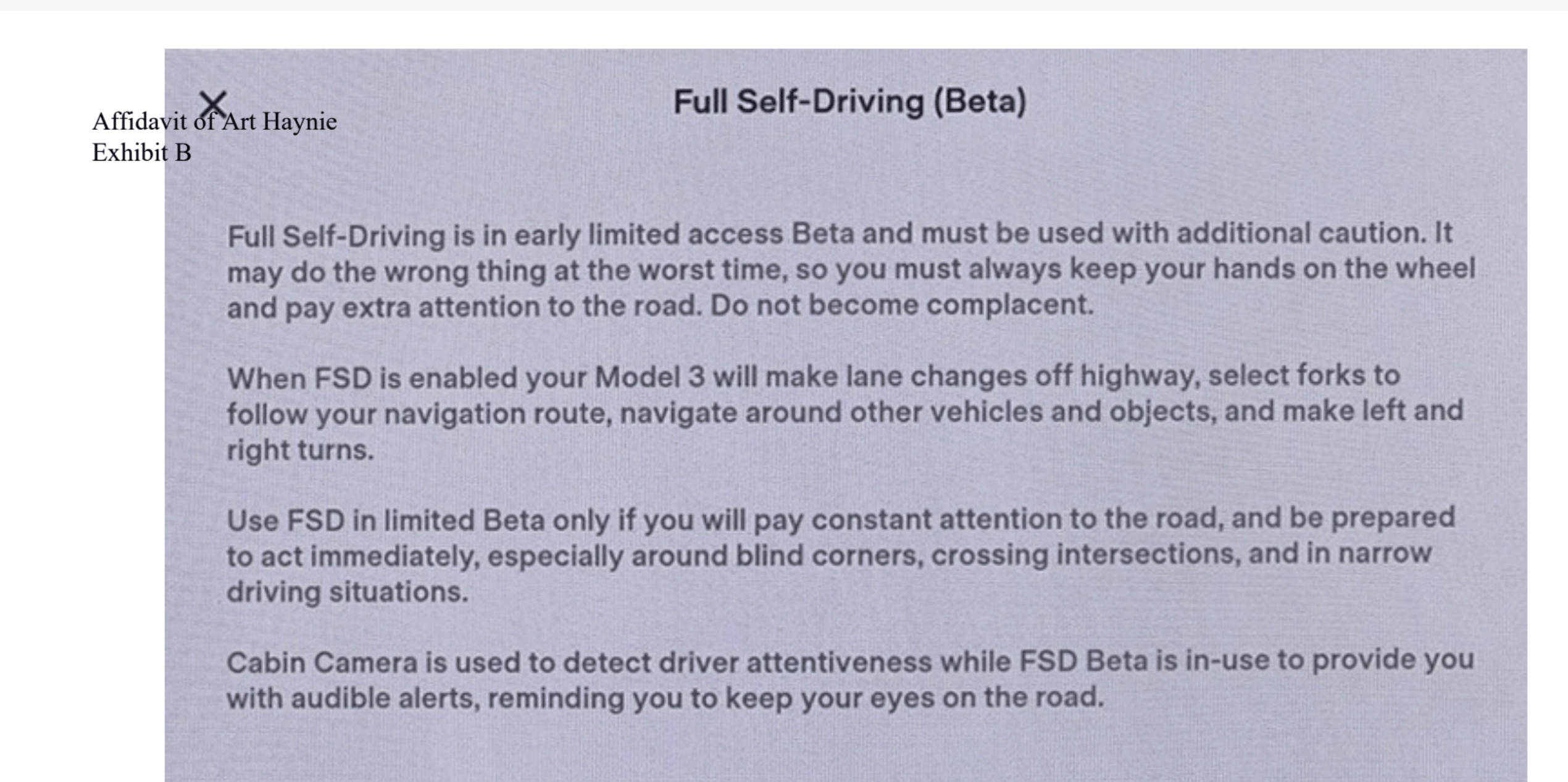
Autopilot, Enhanced Autopilot and Full Self-Driving Capability are intended for use with a fully attentive driver, who has their hands on the wheel and is prepared to take over at any moment. While these features are designed to become more capable over time, the currently enabled features do not make the vehicle autonomous.
and you get warnings source (or here ) when you first sign up, as well as reminders when the car detects that you don’t follow the requirements.
if it disengaged a few seconds before, the crash is still the fault of Tesla’s software.
I actually disagree, because it’s not self driving, it doesn’t actually claim to have any autonomous features. The driver has to be aware all the time.
The way all of this is worded when facing the public is… horrible, that’s true. But since the warnings once in the car seem to all be there, I’d say that’s more a false advertising issue than a “is your product actually safe?” issue.
Really interested in how this comes out, even more data would be interesting to me.
not 100% sure, because weather is a bit device specific.
But usually you should be able to install either weather notification or quickweather (use an API key for OpenWeatherMap) and have that data sync via gadgetbridge to the watch.
And ZeppOS watches (most/all Amazfit watches) are well supported!
Can’t recommend it enough, for anyone privacy conscious at least
Google would likely still bid, but lower, so that Firefox may change over for bing, and still get ~80% of what they got from google. Google has an interest to not make it cheap for microsoft, even if they don’t want to pay a dime themselves.
https://arstechnica.com/cars/2023/09/are-self-driving-cars-already-safer-than-human-drivers/
It seems that both Waymo and Cruise are more likely to already surpass average human driving safety, than not.
I’m really curious on how the next FSD version (which apparently completely relies on neural nets for driving) play out.
Not that I think it’ll be particularily good, just particularily interesting.

Full Cigarettes and Oil Industry moves, but those never habe been an issue in the grand scheme of things, right?