
ruffsl
I’m a robotics researcher. My interests include cybersecurity, repeatable & reproducible research, as well as open source robotics and rust programing.
- 22 Posts
- 12 Comments
 16·4 months ago
Some poignant questions for these new platform requirements:
- How do you anticipate this being used against journalists and advocacy groups?
- What research and statistical quantification will be done to evaluate the amount of harm these restrictions can inflict?
- What precautions or safeguards will users have against malicious state actors or capitulating corporations?
- How can developers protect themselves from liable damages due to service interruptions caused by third party verification?
- Do you foresee legal restrictions in rollout due to national security concerns from differing nation states?
 1·5 months ago
One thing I appreciate about NixOS is the ability to use overlays and override package sources. For example, overlays can be used to selectively install unstable and stable packages alongside each other:
While there may be caveats, this approach has been working for me just fine, as I can install VSCode from unstable to get the most recent monthly releases as they roll out, but then pin the rest of my desktop environment to stable to limit anything else shifting underneath me unexpectedly.
If there was a simple Debian based distro that I could declaratively manage via a single config file, I think I’d try it. I.e. not using Puppet or Chef that can only bootstrap a system state, but something to truly manage a system’s entire life cycle, including removing packages and anything littering the system file tree. But since there isn’t, I’m using NixOS instead.
Having a DSL to declare my entire system install, that I can revision control like any other software project, has been convenient for self documenting my setup and changes/fixes over time. Modularizing that config has been great for managing multiple host machines synchronously, so both my laptop and desktop feel the same without extra admin work.
Nixpkgs also bolsters a lot of bleeding edge releases for the majority of FOSS packages I use, which I’m still getting used to. And because of how the packaging works, it’s also trivial to config the packages to build from customer sources or with custom features. E.g. enabling load monitoring for Nvidia GPUs from
btopthat many distros don’t ship by default.
 6·6 months ago
For the faint of heart, such vicarious pain may require theatrical intermission(s).

 3·10 months ago
On top of that, it’d be nice for the Bluetooth spec to roll out a higher bitrate version of HFP, as it’s common 16 kHz monaural configuration is awful when listening to multimedia while on video calls, like for remote watch parties or just listening to music or playing video games while hanging out on discord. I ended up just buying a USB to TRRS adapter with pass through Power Delivery in order to use my Android device with proper AV quality.

 20·2 years ago
Similarly reported (in more detail) by TechCrunch:

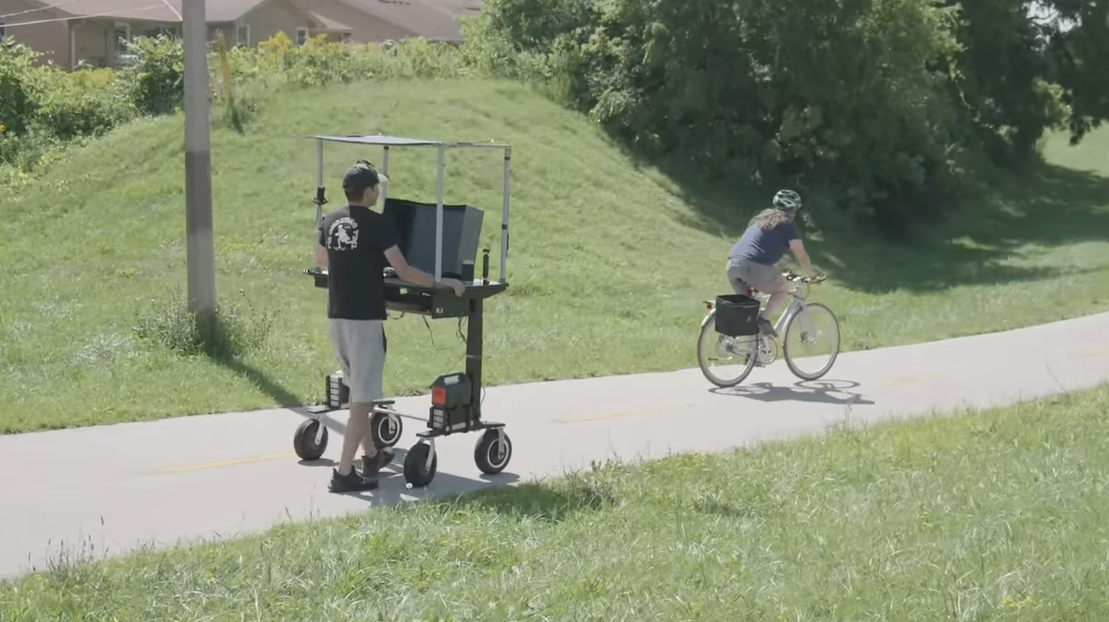
Private Eye - essential for staying online 24/7
What was that device, an early cellular modem or 802.11 wireless bridge? The thing ontop of the briefcase looks like a head visor with an antenna. Google search keywords are just noise.
 1·2 years ago
I’ll note that when using multiple windows, I recall that switching the user in one window would switch the user for all other windows as well, so support for simultaneous user sessions would probably have to be added as well.






Image Transcription: Meme
A photo of an opened semi-trailer unloading a cargo van, with the cargo van rear door open revealing an even smaller blue smart car inside, with each vehicle captioned as “macOS”, “Linux VM” and “Docker” respectively in decreasing font size. Onlookers in the foreground of the photo gawk as a worker opens each vehicle door, revealing a scene like that of russian dolls.
*I’m a human volunteer content transcriber and you could be too! *
What about carrying on a legacy with maintaining a intergenerational codebases? Like from a family owned business, a FOSS project, or hobby video game? Something that span’s across tech stacks, historic trends, and familial code authors, like the ship of Theseus crossed with Noah’s Ark (built with the help of Noah’s entire family over almost 100 years, as the theological mythology goes).
You know how folks inherit tools, workshops, or auto projects from parents and family? Stuff like wood working equipment, sewing machines, or whatever tools of the trade. It’s got me wondering, what’s it like for children that inherit their parents’ codebase, computers, keyboards. Surely with the growth of the tech sector and job market, compared to half a century prior, this could be a growing re-occurrence.
E.g. like the entire premise of this YouTube channel titled “Inheritance Machining”: https://youtu.be/hearLttbrLo
For example, my grandfather worked for IBM, and my family recalls growing up surrounded by punch cards around the house. Of course that form of programming only lasted so long, so the next generation was unlikely to reuse the same tools of the trade, but as tech stacks have matured and interfaces standardized, what are the chances are that folk’s children will use the same Linux kernel modules, custom mechanical keyboards or desktop chassis that their parents used today?
I’ve observed some notable improvements when benchmarking with the CachyOS kernel on NixOS via Chaotic’s Nyx using moderately old hardware:
https://programming.dev/post/38304031
Haven’t yet tried replicating the same comparison on newer hardware, but would be interested to see what others have tested. Any observations?