

§ɦṛɛɗɗịɛ ßịⱺ𝔩ⱺɠịᵴŧ
“I would rather have questions that can’t be answered than answers that can’t be questioned.” – Rich Feynman
- 600 Posts
- 408 Comments
 2·3 months ago
SoundCloud is pretty cool, especially when compared to Spotify. I’ve been really liking the https://sc.maid.zone/ SoundCloud frontend recently, makes it more private and you can download the songs on the same page you can listen to them. But all in all, it really just comes down to your opinion regarding if you should talk positively about it.
 7·4 months ago
Yep, cellulose is a beta pleated sheet, unlike carbs/sugars, which are alpha helices. We’re always ready to breakdown the alpha helices form of sugar, but due to the molecular structure of cellulose, we need help. This is were these enzymes come in from our microbiome. All this also ties into how in Western countries, most folks tend to be unable to breakdown cellulose due to the lack of the specific bacteria in our biome capable of producing this enzyme. However, in African and Asian countries, these bacteria are common place, so these cultures have been able to digest cellulose for ages!
 42·4 months ago
While Nebula is a creator‑owned ad‑free video service, it’s truly just a conventional centrally‑hosted platform collecting user data like most sites. So while ad‑free, it has no focus on privacy as its privacy policy shows standard analytics and tracking typical of most subscription services. This being the case, it’s not a privacy respecting alternative to YouTube like Peer Tube much at all unfortunately.
 2·4 months ago
Well said!!
Cookies do not directly communicate your IP address, they’re just bits of data about your visit. Logging out of LinkedIn and closing your browser should clear them, unless they’re persistent cookies.
Using a VPN to create a new Spotify account maskes your actual IP address. Meaning spotify wont know your home IP address. But, if Spotify uses cookies from your previous sessions or if you log in with the same credentials, it may still serve targeted ads based on your previous activity.
So while cookies don’t transmit your IP address, they still influence the ads you see based on your browsing history and/or account information. For enhanced privacy, it’s usually recommended to set cookies to be wiped when you close the browser. I have a handful of sites I like to keep cookies for, but everything else is gone after each session.
 10·9 months ago
For anyone new to the Linux world, I can’t recommend Learn Linux TV enough. He has a video walking through this exact process, here’s an Invidious and YouTube link for it.
As far as dual booting goes, issues can arise after updates. I recall this happening a few months back due to a Windows update. So just be aware of this possibly happening down the road. I need Windows for work at times too, but I strictly use a VM. I’ve hated Microsoft since Windows 8, their amount of user tracking is bonkers and a big part of why I just use a VM. This is just food for thought though.
JMP Chat works in the US even though they’re based in Canada. I highly recommend the service, it’s absolutely fantastic!
Definitely checkout JMP Chat, they’re actually based in Canada and offer super affordable alternative phone numbers. Using their Cheogram app even lets you incorporate it fully into your phone, so when you call, it’ll ask which number you’d like to use for the call. Calling has limited minutes each month, but the overage charges are very reasonable. It comes with unlimited texting as well. They encrypt everything on their end and it’s fully open source!
The add-on’s are solid. They have an elaborate curated list, plus you can access any of the mobile extentions by just searching for em.
Obsidian isn’t FOSS, but two fantastic replacements are Standard Notes and Notesnook.
A great paint option I don’t see listed is KolourPaint, plus Kdenlive for video editing. For audio editing, Tenacity is the better choice over Audacity. It’s an Audacity fork made after some questionable privacy policy changes.
CryptPad is an awesome Google Doc’s replacement, but Libre Office is actively working on their version too.
For your security section, adding some encryption software would be smart. Both VeraCrypt and Cryptomator are amazing. Also, Bitwarden/Vaultwarden are solid password manager alts for KeePassXC, with Vaultwarden being self hosted.
Here’s a great site for all sorts of Lemmy clients.
As far as Linux laptops go, System 76’s Darter Pro is also a solid choice. Tuxedo is probably System 76’s biggest competition, as they offer very comparable laptops. Their InfinityBook Pro is a great computer. Frameworks, Slimbook, and Star Labs are all also worth a mention.
Definitely recommend replacing Fennec with IronFox on mobile, it’s a fork of Mull, so it’ll be a solid privacy upgrade!
I ended that last chunck of text with /s. But at the same time, it wouldn’t suprise me at all if this was the case.
A virtual machine is the move, I’ve had a great experience with virt-manager. Strongly recommend debloating the windows VM if Microsoft is getting on your nerves. Here’s my go to software: https://github.com/raphire/win11debloat
Worksorks on both windows 10 & 11. It’ll allow you to remove telemetry, tracking, and even software Microsoft prevents you from uninstalling. I just can’t get it to remove Edge. But MentalOutlaw has a fantastic walk through of the process on his YT channel if you want some guidance with the debloating process.
Baby
NextDNS is the move, the clients are open sourced and they encrypt everything. Plus their free option covers all my devices, no problem. Highly recommended!
I’ve been really liking the KISS Launcher, it’s power is in it’s simplicity. It also looks relatively comparable with Smart Launcher. What’s super impressive about the KISS Launcher is that 93% of users that try it for a week are still active users after 3 years! So definitely worth a gander for sure.

You’re server’s #3 when it comes to monthly active users too!
When you sort by monthly active users, this is what you get:
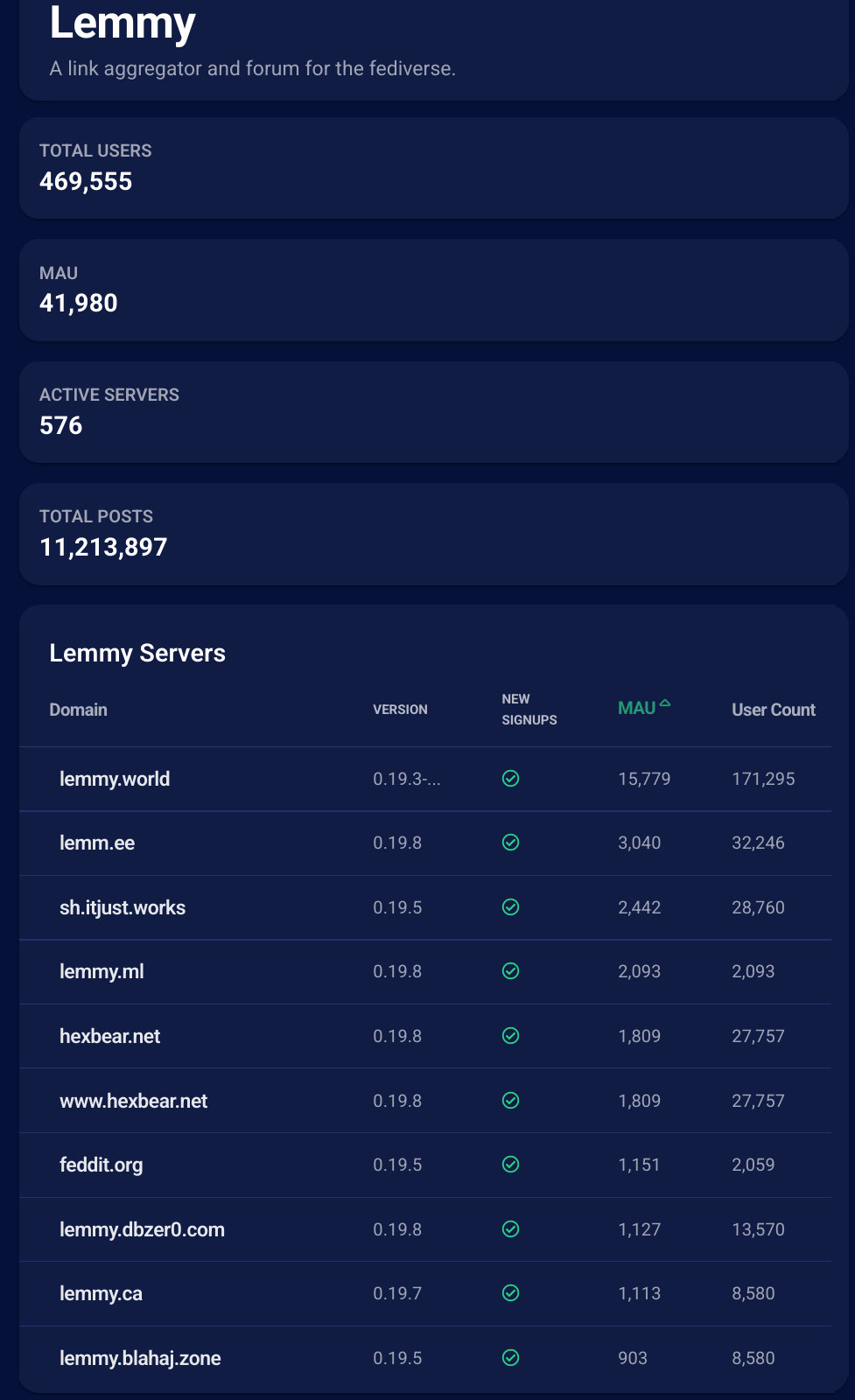
What really jumps out to me is the fact .ml’s active users equals the total users. Not too sure what to make of it. I’d assume the mod’s delete nonactive accounts after a set amount of time or it’s just relatively small based on total users but everyone’s visiting at least once a month.
I hear what you’re saying, but I wanted to point out that any living organism is built from the same 20 amino acids, which are put together based on a blueprint (aka DNA). A string of amino acids is called a polypeptide, which is also known as a protein. But both dogs and wolves are omnivores, it’s a common misconception to think they’re carnivorous. Cats on the other hand are carnivorous creatures.
Additionally, it is not necessarily true that carnivores are more intelligent than omnivores or herbivores as a result of their diet. Instead, predators and prey are in a contest of brain size relative to body size. While carnivores and omnivores have more potential opportunity to develop intelligence, they’d have to be a social species for that to occur. So relative brain size and intelligence aren’t directly associated with diet, but more so a result of social structures and genetics.
Not sure what’s up with Nature’s website on your end, but here’s the link that’s working for me to access the paper, which was published today (10-3-25): https://dx.doi.org/10.1038/s43018-025-01054-6
Nonetheless, a paper from 6 years ago studying a receptor found on almost half of immune cells should have more current information available by now, if not already. In science, we build on the shoulders of giants and try to expand on the knowledge they helped us understand. Additionally, the older study examines SLAMF6’s function across health and disease, so it’s much more generalized. The new study aims to provide additional context for the earlier findings and focuses on acute myeloid leukemia in particular. I have a PhD in immunology, and it’s astonishing how little we actually understand about the subject. All in all, we understand the ocean better than the immune system, even though there’s more we don’t know about the ocean than we do. Even crazier is that most of our current understanding in immunology is actually for a rat’s immune system and not humans! But you’re not wrong to be cautious, all research papers should be read with a healthy amount of scrutiny. A wise man told me in undergrad that half of what we’d cover in the course would be incorrect, we just don’t know which half.