http://existentialcomics.com/comic/636
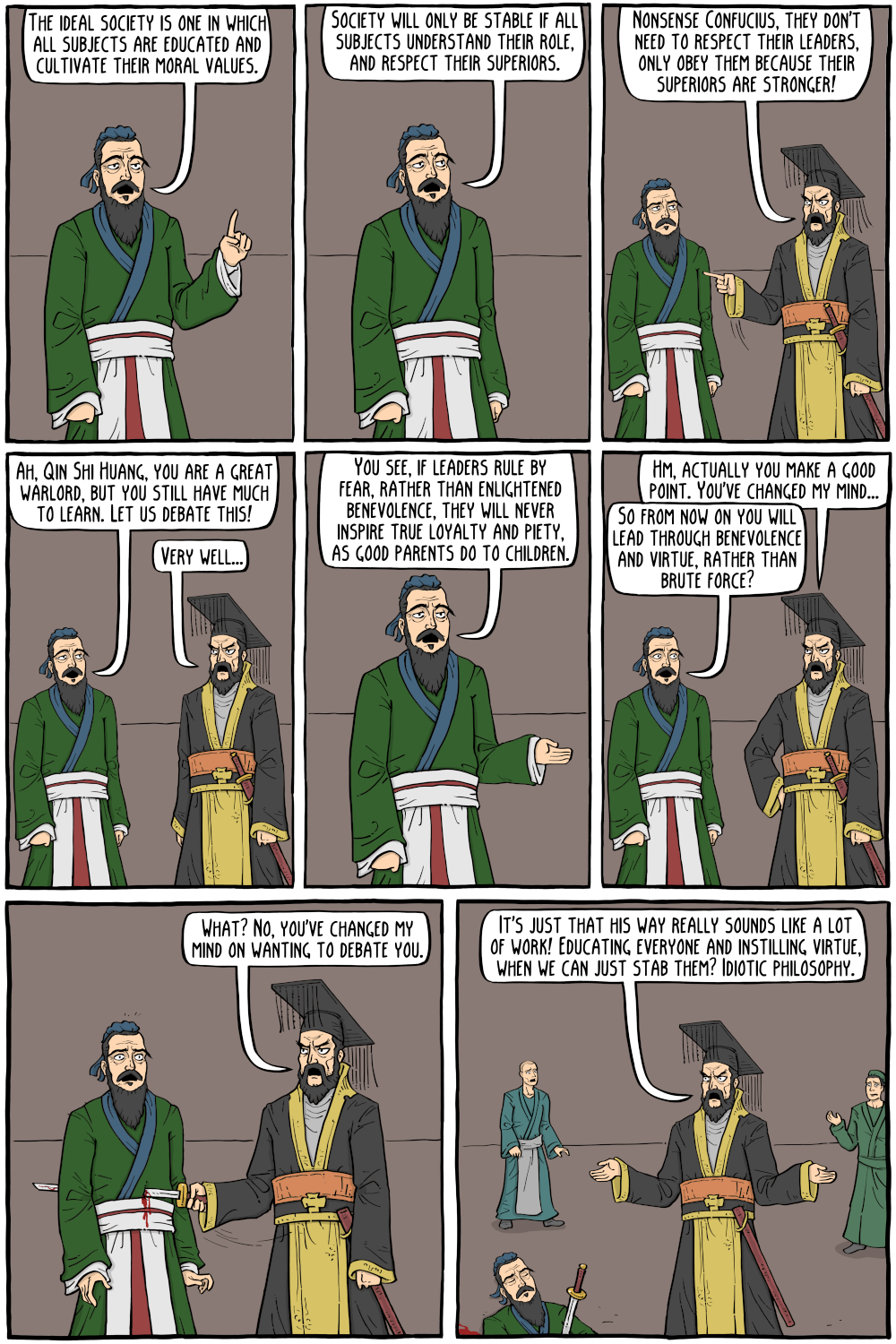
Confucius believed a harmonious society was one where everyone understood and embraced their role, and were educated in proper virtue. In Confucian philosophy, most societal structures mirror the relationship of a family, so just as a children are taught to respect their parents, so are servants taught to respect their superiors in social rank. This respect was to be earned, however, by equal virtue of the parents and masters in taking care of those below them with benevolence, and other virtues (the five major virtues being: Benevolence (Ren), Righteousness (Yi), Propriety (Li), Wisdom (Zhi), and Trustworthiness (Xin)).
Qin Shi Huang, the first emperor of China, who united the warring tribes that Confucius had lived under, ended up supposedly killing an enormous number of Confucian scholars, and banned Confucius thought in favor of Legalism. Legalism is basically the same thing, where everyone in society is to embrace their role in society, except without all the blabbering on and on about how it is virtuous and good. They are to embrace their role because that is the law, and if they don’t the emperor is going to cut their head off. More or less.
everyone understood and embraced their role
It is also important to note the historical context of this sentence. At the time of Confucius, social role is very much assigned by birth, where the first child of wife (not concubine) called 嫡长子 would inherit the social status and class of the father, yet others move down one status, until the lowest of your social class (for example, the lowest class of aristocrat 士 usually do not move down to common person, and common person do not move down to slave).
In general, Confucius promoted strict and stiff social hierarchy: love towards others should respect such structure; also a lot of its education is about the proper behavior within this social structure. One famous example is “八佾舞于庭, 是可忍也, 孰不可忍也”: “If we allow 8-by-8 dancing (for an official), what can’t we allow?!” The dance with 8-by-8 dancer is intended for the king according the old law (周礼), officials are only allowed 4-by-4. This strict adherence to hierarchy and traditional rules likely explains popularity of Confuicism in the feudalist China.
On the other hand, Qin famously adopted the philosophy of 法家 (Fa, translated to “law”), which significantly contributed to the rise of Qin. Philosophy of Fa advocates that everyone is equal under the law (including royals and aristocrat), and rapid promotion of social classes via contribution in war and policy, which is not aligned with the philosophy of Confucius. However, Fa also promoted cruel punishments like murdering entire families, even neighbors, because the fault of one person, and spliting a person alive by five horses riding towards different directions.
There are other philosophy in that era, one of my favorite is Mo (墨), which believe to made up of lower-class artisans and workers. They promoted universal and unconditional care and love, reduce consumption, rejection of destiny, and also one of the harshest critic of Confucius’ ideal. Obviously they are not terribly popular with the ruling class. A fun fact about Moism is that they are believed by some to be the first to describe Newton’s first law, lever, definition of a circle (圆,一中同长也 translated to “a circle is [points with] equal distance to the center”) , and Camera obscura.
I love how this comic is letting me learn more Chinese history!