
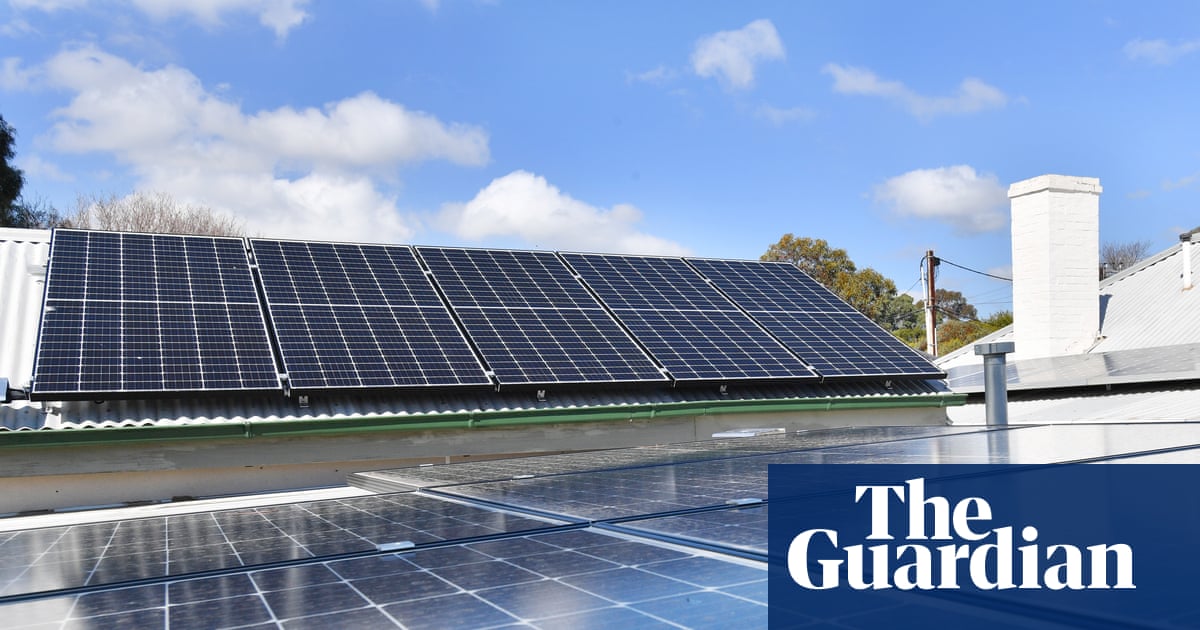
Australian households in three states will be promised access to at least three hours a day of free solar power, regardless of whether they have rooftop panels, the federal government has announced.
The “solar sharer” offer will be available to homes with smart meters – which is the majority of homes – in New South Wales, south-east Queensland and South Australia from July next year, with other areas to potentially follow in 2027.
The government said Australians could schedule appliances such as washing machines, dishwashers and air conditioners and charge electric vehicles and household batteries during this time.
More coverage on the ABC: Energy retailers to be directed to offer free power three hours a day
PS: Australia wastes a lot of our renewable energy because of insufficient storage during the day. The data of our energy generation can be seen on OpenElectricity [edit: fixed link]. The shaded section on top is the amount of renewables which are “curtailed” (turned off due to insufficient storage), and the little bit below the zero line is the amount that actually gets stored in batteries or pumped hydro.
Because coal power can’t turn on and off easily, we burn coal 24/7 for power and throw away 10% of our renewable generation. Hence this policy, to encourage more use during the day when we can use more renewable power. Some retailers have been already offering this as “happy hours” or “three for free” during the solar peak.
There are even a few retailers that vary their charges (pun intended) based on current (intended again) wholesale rates - because of all the excess solar, electricity through those providers is often completely free from 9-10am to 3-4pm.
Very cool about why they’re doing it!
But separately, i just looked at that chart at the top of the page, are you sure you’re reading that right? What you described doesn’t seem to be what the chart is showing. Maybe I’m the one reading it wrong, but the top chart is just showing amount of electricity generated by source type. Anything above zero is the amount of electricity that was generated.
This link should show curtailment on. There should be a white-shaded bit at the very top (if not, click on the box on the left side under “Curtailment” and next to “Renewables”).
Yup that link works now, thanks!
It’s great to run the AC in the middle of hot days.
I’ve only really seen commercially available thermal batteries for heating, but i think it’s absolutely a solvable problem for cooling.
The idea is that you heat (or cool) a large thermal mass when energy is cheap, and then you distribute that heat (or coolness?) later. Water is the obviously easy thermal mass. The math (and usage) is pretty easy for heating since the amount of energy stored is just massspecific heatdelta_T.
For cooling, you can take advantage of the huge amount of energy it takes to freeze water. For example, it takes about the same amount of energy to go from ice-liquid water at 0°C as it does to then heat that water to 80°C. The trouble is that you can’t just pump ice around like you can hot water, so the system has tools be more complicated.
I wonder if it’ll be worthwhile to buy a home battery even just to store the free energy. Could be a very interesting way to incentivise distributed storage especially with the home battery rebates.
People with Amber electricity are making money off their home batteries.
It exists and is running.
I think there will be more appliances that come with batteries built in too. There are already fridges and induction stoves that come with dual battery/mains power.
Make a business that pumps water up hill for 3 hours and sell it back at night?
https://duckduckgo.com/?t=fpas&q=snowy+hydro+2.0&ia=web
working on it, bazillion over budget and tbc years late.
i think we have some smaller pumped hydro projects that aren’t a cluster fuck.
batteries are just cheaper and less risky.
But don’t last as long…
This works a lot better. https://en.wikipedia.org/wiki/Sodium-ion_battery
Says they’re good for 2-5 years for full daily cycling.
Not bad not super… Pump and turbines still sounds more eco.
Sounds more eco maybe, significantly less efficient, and the amount of area you’d need would be pretty massive. You lose energy to the pump and the turbine. Chemical energy storage is the most efficient, the batteries can be recycled. Lithium iron phosphate batteries are another option. https://en.wikipedia.org/wiki/Lithium_iron_phosphate_battery