The hopium is that with Biden’s 30% federal rebate from the Inflation Reduction Act I was able to install a full large personal solar setup last year, and it was one of the best decisions I’ve made.
There are many places/people with higher energy costs and/or lower labor costs should be jumping on solar immediately, just for the financial and reliability reasons, not counting the environmental reasons (that so few care to put money into).
If the US still had the 30% credit, I’d be shouting from the rooftops for anyone who will live in their place for the next ten years to be jumping on this.
Battery tech coming along really helps too. If the batteries get just a bit better, than everyone with money should be running solar. The grid is for poors. Why wouldn’t you be independent if you could?
We’re really close, and if the governments wanted to push it again, we could speed it up massively.
How is that solar ocean freighter doing?
It’s a huge undertaking, but if the political will was there we could massively reduce carbon emissions. The tech is close enough.
Well, the blog is literally called “climatehopium”, so, eeeh…
There are certainly some major challenges for a transition to clean energy ahead. The majority still seems to not see the necessity, or at least not don’t see why they should change anything.
Also, as a nitpick, with 8 billion people on the earth, even a scenario where 1 or 2 billion people die, either from lack of food or water or from the resulting struggles for the remaining resources, is technically not “truly apocalyptic”.
The majority just want what’s cheap; I think the blog makes this argument well. Renewables are cheaper for the vast majority of applications, and so they become the responsible, pragmatic, easy, automatic thing to do.
editing to add: ‘avoiding apocalyptic levels of warning’ = ‘halved expected total warming as of late ~2024’. This particular nugget of hopium was from before iran war, and so we’re likely to see further reductions as the models update over the next ~year
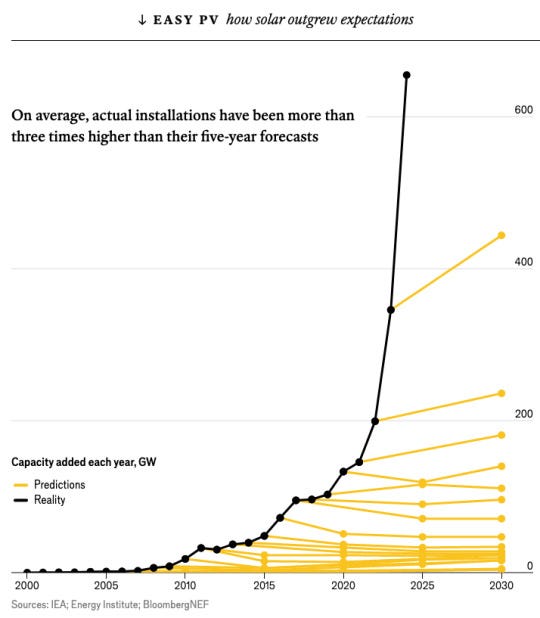
We will see for sure at the end of this year, but solar + batteries uptake is way up already in most of the world. I do think we have already hit peak fossil fuel consumption



Is this true?
No. We’re still putting more CO2 into the air than we did last year. And we set that record every year.
It’s great that solar is growing faster than expected, but that just puts a dent in this chart for now.
Even if we went to zero CO2 emissions tomorrow, I don’t know that our problem would be fully solved. Though it’d be great to stop making it worse.
The hopium is that with Biden’s 30% federal rebate from the Inflation Reduction Act I was able to install a full large personal solar setup last year, and it was one of the best decisions I’ve made.
Details in this post. https://lemmy.world/post/32326227
There are many places/people with higher energy costs and/or lower labor costs should be jumping on solar immediately, just for the financial and reliability reasons, not counting the environmental reasons (that so few care to put money into).
If the US still had the 30% credit, I’d be shouting from the rooftops for anyone who will live in their place for the next ten years to be jumping on this.
Battery tech coming along really helps too. If the batteries get just a bit better, than everyone with money should be running solar. The grid is for poors. Why wouldn’t you be independent if you could?
We’re really close, and if the governments wanted to push it again, we could speed it up massively.
How is that solar ocean freighter doing?
It’s a huge undertaking, but if the political will was there we could massively reduce carbon emissions. The tech is close enough.
Well, the blog is literally called “climatehopium”, so, eeeh…
There are certainly some major challenges for a transition to clean energy ahead. The majority still seems to not see the necessity, or at least not don’t see why they should change anything.
Also, as a nitpick, with 8 billion people on the earth, even a scenario where 1 or 2 billion people die, either from lack of food or water or from the resulting struggles for the remaining resources, is technically not “truly apocalyptic”.
The majority just want what’s cheap; I think the blog makes this argument well. Renewables are cheaper for the vast majority of applications, and so they become the responsible, pragmatic, easy, automatic thing to do.
editing to add: ‘avoiding apocalyptic levels of warning’ = ‘halved expected total warming as of late ~2024’. This particular nugget of hopium was from before iran war, and so we’re likely to see further reductions as the models update over the next ~year
We will see for sure at the end of this year, but solar + batteries uptake is way up already in most of the world. I do think we have already hit peak fossil fuel consumption
no