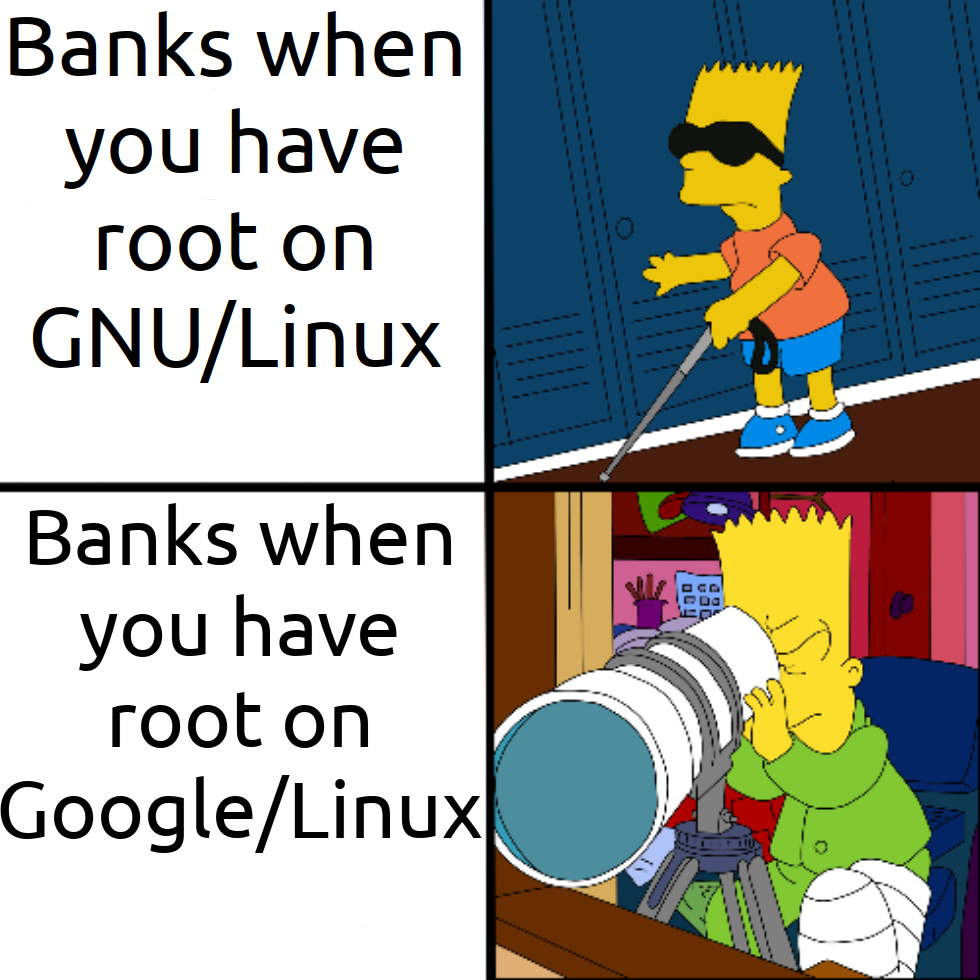
They 100% would stop you if they could.
It’s why Google’s website DRM thing was so scary.
Was? What did I miss? Even if it was discarded, there will aways be another attempt.
Basically Google wanted to put checksums in webpages and then not render the page period if the checksum didn’t match and said checksum could only be verified by “approved” browsers that had the correct certificate (which surprise was Chromium only browsers such as Chrome and probably Edge). As such you wouldn’t have been able to run any adblockers as that would change the checksum and the way the page was rendered. They could also then go one step further and do a Denouvo type set up to make sure the OS wasn’t being altered.
Yes, I know about what they attempted (actually published some of it already in an official repo).
But why you talk in past tense? Have they reverted the changes and publicly pinky-promised not to do it?
Super useful technology for security purposes!
Super scary technology for literally everything else.
deleted by creator
Okay, so I originally was going to go in a long rant about how they’re still doing it, but decided that it didn’t really add much to the comment, so removed it.
Afaik they’ve, for now at least, shelved it in browsers, but are still going ahead in Android webviews (as part of their war on Youtube Vanced).
deleted by creator
I actually heard something about that in class not long ago
The story is that Android’s security heavily relies on the compartmentalization of apps that lives in the android layer, over the Linux kernel. Apparently, that functionality works in part because only this layer can perform operations that require root access, no app or user can. So software that allows you to root your phone apparently breaks this requirement, and makes the whole OS insecure. He even heavily implied that one should never root their phone with ‘free’ software found on the internet because that was usually a front for some nefarious shit regarding your data.
I’m just parroting a half-understood and half-remebered speech from a security expert. His credentials were impressive but I have no ability to judge that critically, if anyone knows more about this feel free to correct me.
Isn’t saying that allowing apps to have root lets them access anything just describing what root is? A rooted phone doesn’t have to give superuser access to every app.
deleted by creator
A rooted phone doesn’t have to give superuser access to every app.
Sure, but apps that run as superuser can access anything, including the data and memory for banking apps. A big part of Android’s security model is that each app runs as a different user and can’t touch data that’s exclusively owned by another user.
It just means you need to trust apps that you give root access to, or only give elevated privileges during the very specific times when apps need them. Root isn’t something people who don’t know what they’re doing should be messing around with, I guess. But I’d think a lot of people who root their phone know and accept the risks.
People like you or I may know what we’re doing with a rooted device, but I think the issue for the banks is that they can’t guarantee that someone with a rooted phone knows what they’re doing or isn’t using a malicious app, so they have to be cautious and block all rooted phones.
An app that requires root may look like a normal app but it could be a trojan that modifies banking apps in the background (eg patches them on disk or in RAM so transfers done through the app go to a different recipient). There’s been malicious apps in the Play Store in the past, and rooted apps have way less oversight - some are literally just APK files attached to XDA-Developers posts or random blog sites.
I take your point, and I’m sure you’re right about the banks’ rationale, but in my own view it does not seem like it should be the banks’ decision to make.
I wouldn’t even feel compelled to root my phones if Google would actually back up my phone instead of whatever 1/4 baked shit they’ve done thus far.
I’ve been using android since 2010, and it’s gotten significantly better over the years. There’s only a few things it doesn’t back up, like text messages and app data, most of which you don’t need.
Mine backs up my text messages, but I would prefer to backup my app data, authenticators, wallpaper, themes, games, etc., not every app is a shitty front-end to a website.
The problem is very simple - the majority of people are technically illiterate. Apple and Google saw the Windows XP security fiasco, looked at how many people use smart phones today and decided that giving users any rights is not worth the risk.
Google/Linux == Android?
Because they want to “protect” you from “yourself”. Imagine, you could scrape your own data that you can already see.
I’d be really worried if the security of server operation for my bank depended on the client-side. But playing devils advocate, some people will most likely point out that a root exploit on a phone may be unintentional and used to spy on people, to which I answer:
- show me a big scary box where I can “accept the risk” and move on
- keep in mind that if I am root on my phone, I can hide the fact that I am root on my phone and you’ll be none the wiser
Currently, option 2 is in effect, sadly.
I just want my bank to allow me to use some other form of authentication besides just a password.