

cross-posted from: https://scribe.disroot.org/post/6440135
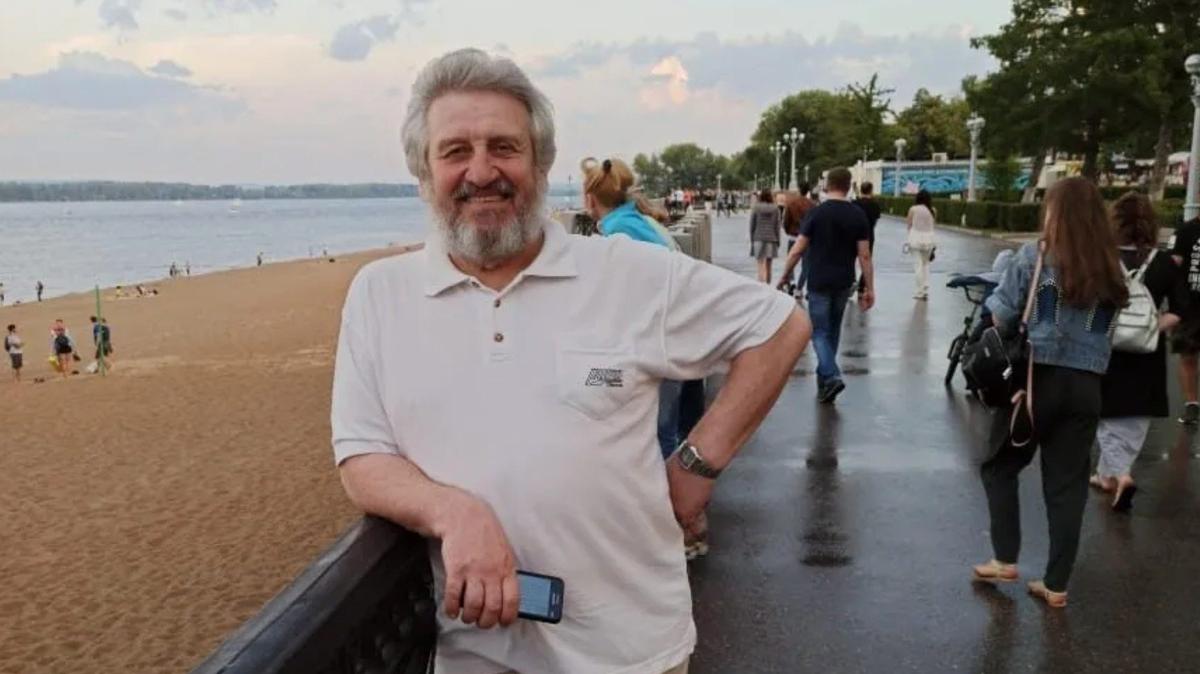
A politician in the Russian Volga region city of Samara has been charged with “abusing press freedom” for a speech he gave in the regional assembly condemning Vladimir Putin and the war in Ukraine, independent news channel 7x7 Horizontal Russia reported on Thursday.
Grigory Yeremeyev, 69, a member of the Democratic Party of Russia, a party founded in the 1990s that is currently unrepresented at any level of government in the country, faces a fine of up to 100,000 rubles (€1,080) over a speech he gave in late December when he was the only politician to accept the annual invitation to parties not represented in the Samara Regional Duma to address the assembly.
Yeremeyev also posted a transcript of his speech online, in which he said that Vladimir Putin had “long since understood the error” of invading Ukraine, but was now unable to withdraw his troops without going down in history as having lost the war.
Yeremeyev suggested that the Samara deputies should apologise to their constituents, “share responsibility for the failure with Putin” and advise him to stop the invasion, and urged the body to encourage other regional parliaments to vote for a similar initiative.
Continuing the war would lead to the “moral degradation of both parties to the conflict” as propaganda and the daily murder of hundreds of citizens “become commonplace”, Yeremeyev warned. He said that if NATO could not defeat Russia, and vice versa, “the special military operation would crush human lives and destinies” and was “an irrational waste of financial resources”.
…
The Duma also passed a resolution calling for Yeremeyev to be assessed as a “foreign agent”, and describing his speech as “a deliberate attempt to discredit” the assembly.
That ship has sailed a long time ago. I lived in russia in the 90s and 2000s (I speak fluent russian, still have a mild moscow accent that people bring up if I am not speaking English/Ukrainian). It’s very clear that putin is a symptom and the cause is russian society (not every single person of course, but the overwhelming majority).
Forget about Ukraine for a second. If one truly want change in russian society, one has to look at the “results” shown by the russian opposition in the last ~25 years. Even with implicit support of imperialism (не бутерброд с колбасой), it has been a comical failure in every way imaginable.
Yeremeyev is just doing the same fucking thing. Yeremeyev (or whoever) wants change? Then raise at least 50 battalions of russian troops to join RVC/РДК. Anything less than that is either childishly naive or russian “liberal” bullshit that in reality is a lite form of imperialism (why choose a putin lite regime when you can have the real thing?).
To some degree, I agree - but a detailed view is beneficial.
I’ll give the diagnosis first: Russia remains an empire with suppressed regions and suppressed ethnic groups. This feature almost guarantees that whoever rules will worry about separatism, is likely to grant lots of power to 3-letter agencies -> this means they’re available to repress domestic opposition.
The progression of the disease can be observed.
1980-ties: everyone was tired of the USSR being in stagnation and falling behind, preference for democracy became widespread, Gorbachev attempted reforms but lost control of the economy, allowed free elections and subsequently lost all authority (personality profile: he was economically incorruptible but also incompetent, and also an inefficient organizer).
1991: seeing Gorbachev lose control, the August coupers temporarily ousted him, but ended up triggering the dissolution of the USSR, since parallel power was already well developed on the level of individual SSRs (in Russia, it was vested in Yeltsin), but preference for democracy was still widespread in society. Military units disobeyed, people came to protest by large numbers.
1990-ties: everyone got tired of economic turmoil, corruption and organized crime. Yeltsin entered a power struggle with the Supreme Soviet and during the constitutional crisis, used military force against the parliament. He was still popular, but enacted reforms to give the president unchecked power. I would suggest that Yeltsin’s personality profile might have been “corrupt alcoholic with good instincts but despotic tendencies, average organizer”. Yeltsin knew his health was failing and popularity fading - he selected Putin, installed Putin and booted Putin up. And started giving three letter agencies unchecked power to fight Chechen separatism.
Half-diagnosis: it could have been different if the decision had been made to let Chechnia go. The decision to use armed forces to subdue separatism catalyzed both the arrival of Putin (he had a suitable profile to manage suppression) and created the environment for things to happen his way.
(At this point in the narrative, the agency of society starts decreasing and the agency of one guy starts increasing.)
2000s: the only period when the economy actually improved. Putin got the credit and was viewed as a saviour, despite having done little to achieve this. He welcomed the power Yeltsin handed him, protected Yeltsin and his accomplices from any review or prosecution, allowed Yeltsin’s family to keep stolen riches and let the ex-president die in peace. Meanwhile, he staffed media, law enforcement and armed services with loyal people, surrounded himself with accomplices and created a party (United Russia) to pretend democracy. The general population was experiencing economic improvement and were politically illiterate, they just let it happen. A characterization of Putin during this decade might be: efficient, motivated, corrupt, good organizer. Since nearly everyone was corrupt, nearly everyone could be blackmailed to comply. Every business oligarch or local leader could be told “we know what you’re doing, you could be charged 10 times over, but if you obey, we’ll let you continue doing it”. Personally, I think this approach was crucial. IMHO this was the recipe Russia was taken over with - Putin became the grand vizier of corruption. His hierarchy accepted it, controlled it and licensed it for obedience.
(At this point, opposition still existed and its main organizers weren’t threatened with death, but the playing field was already tilted against them.)
2008: war against Georgia boosted Putin’s ratings. “I have mastered the art of a small successful war” might have been his conclusion.
2010s: economic crisis hit the world and likewise hit Russia. Discontent appeared because living standards were dropping. Taking over the last bits of media was a struggle, resistance appeared. Elections could be already “won” without the people consenting (central TV and vote counting was under “good” control). Putin ran out of terms, but was not ready to drop pretenses. He needed cover and let Medvedyev rule for one term, then resumed presidency. The party he had created was handy for this purpose.
2014: revolution in Ukraine opened a window of opportunity, Putin calculated correctly that annexing Crimea without much resistance would bring him popularity as a military victor. Media was already fully controlled and presented him as such for maximum effect. Ukraine was unable to mount a defense. Western sanctions were half-assed. There was no downside, no punishment for the deed. “I have mastered the art of annexation,” might have been his conclusion. But he was growing old and increasingly surrounded by yes-men. He most likely started approving orders to kill opposition leaders, and some were indeed killed. The last effective opposition leader might have been Nemtsov. Navalny and Kara-Murza already had no hope, but tried regardless.
2022: threat of catching COVID has made Putin extremely isolated. Perhaps he’d become aware of being mortal and wanted to leave a legacy. Perhaps circles of yes-men assured him that yes-they-could (in three days). One thing could have still happened: the West (which had started raising defense spending in 2014, after Crimea) could have mounted a convincing deterrence. The West could have said “we’ll do everything it takes to keep Ukraine intact” and it would have worked. But the West did an unconvincing deterrence. Ukrainians probably didn’t fully believe he’d try to conquer, because they kind of knew his troops were too little to conquer them. And it started.
At this point, any critic could be labeled a traitor and disposed of in a wide variety of ways. People’s agency had reached a minimum. As the state ran into a dead end and Ukraine proved such a tough cookie to bite, people’s agency started very slowly rising, because he needs to arm a certain amount of people and the low-ranking loyal are increasinly dead. But it has not risen anywhere appreciable. :(
The ultimate problem, I think, is that people have been indifferent to injustice (as long as they have bread and circus), easy to manipulate (illiterate about politics and propaganda) and really poorly informed about world affairs (many haven’t ever traveled abroad, and speak no foreign language).
The task of manipulation becomes even easier if they have chip on their shoulder (e.g. perceived indignity of historical collapse). And even easier if large groups consume information only from Russian language TV - it can be taken over and used to brainwash them.
Now, after 2 decades of increasing deception / repression, they’re trapped. If they want out, they need to overthrow their institutions, but very few are capable of wanting that. Of my anarchist comrades, most are in exile or hiding, or in prison.
Levada’s recent study, unless I recall wrong, showed wide consensus among groups (even the “I don’t approve of Putin” group) that economic protest is not likely (less than 20% considered it possible) and political protest is even harder (I think this indicator was below 15%). Apparently extra bad in Moscow. In the regions, you might find space to disagree, but Moscow has central institutions, gets policed harder and excempted from burdensome measures. Putin wants the capital to be particularly safe for his reign.
I don’t know what will get him out, but speeches like the articles describes - will not. But it’s nice if people try. A challenge of some kind, even if doomed to fail, raises the social temperature at least a bit.
There is quite a lot to unpack, so let me ask a few more holistic questions.
Is there a point at which historical / systematic / external factors can no longer serve as a justification (however nuanced) for the pro-authoritarian, pro-imperialist direction of russian society (let’s say that if one disagrees with this characterization, we replace the word society with polity or “russia as a country”)?
If such a point does not exist outside of the most extreme cases, is there a semi-realistic scenario where such factors do not come into play and russian society is able to move beyond authoritarianism, imperialism and being “easy to manipulate”?
I personally disagree with what I see as a victim-hood narrative, a very measured and nuanced one as described in your post, but still fundamentally a victim-hood narrative (in my eyes).
Even Navalniy, the darling of the west, was openly supportive of imperialism and and a fundamentally chauvinistic outlook on international relations.
And this lack of desire to address such deep rooted and near universal chauvinism; (85% of russians supported the annexation of Crimea even with adjustments for preference falsification) is why russia cannot progress beyond thuggish monsters as leaders for life. Why choose Navalniy when you choose the real deal (i.e. putin)?
P.S. I lived in russia in the 90s and 2000s, our family speaks fluent russian even though we are not russian.
I’m not Russian either, despite my username pointing there in language space. I’m actually Estonian, and have been watching this train wreck from one click away. I speak Russian a bit more fluently than Ukrainian, but both skills are rusty.
I think a victimhood / injustice narrative must be acknowledged if the goal is to understand how things got to the current point. One doesn’t have to agree with it, and victims don’t get automatic pardon if they become criminals.
As for Navalny - at the point when many people who were against Putin kind of supported him, he was the only guy still kicking who could have made a difference. He also kept kicking long enough that he managed to change during his journey. I should note that he had no fear, to the point of being suicidal in the end game. :o He went back home to become a martyr. His friends should have knocked him out instead of letting him onto a plane headed for Moscow (which got diverted anyway to arrest him more privately).
He was rational in some sense. He focused on corruption and living standards, and if one asked around, corruption and living standards were issues that people cared about. In a poll, rule of law, human rights and democracy were bottom tier topics, but corruption was the visible and ugly face of state going illegitimate. Navalny knew that everyone hasn’t studied political science and made his goals simple enough for a tractor driver to understand. At one point, he received 1/3 of the votes in the municipal elections in Moscow, so his approach (before further clamp-downs) worked for a moment - he was one inch away from being mayor of Moscow. Later he was charged, prevented from running, demolished, imprisoned and probably killed.
He was a tragic figure in one particular way. Being half-Ukrainian (his relatives were from the Chornobyl region and as teen, he briefly managed to forget Russian and speak Ukrainian for one summer) - he held on to the idea of Russians and Ukrainians being brothers when others had already let it go. And he was a hostage of Putin’s popularity, and made ridiculous compromises and verbal acrobatic tricks on the subject of Crimea (writing this, I recall the “Crimea is not a sandwich” comment).
But the point of people choosing him - and he later (when barred from running) advising voters to choose the strongest non-Edinaya-Rossiya candidate in each district - was tactical: “choose the strongest challenger to the tyrant and hope to sort it out later”.
As for people being politically illiterate… despair is appropriate in several countries, but Russia gets a special mention. I wonder if there exists a country where voters are universally mindful of their actual needs, see through political tricks, have empathy towards out-groups and foreign countries, and don’t create a clusterf**k eventually. I’m not sure if one exists currently, but I believe such a country might be possible to create. Not in the borders of present-day Russia, however. Recently I’ve been looking at the US, and I’m seeing similar tendencies, fortunately at a lower level. Many of them can’t figure out international policy. Caring about what happens abroad has never been very popular, there is too much US around to care about. Just as others, they don’t see through tricks, their electoral system isn’t under severe influence yet, but can be gamed with money and is very polarizing…
…and the same, at an even lower level (possibly because over here, it’s impossible to ignore international politics) happens in the country where I live too. People can be tricked with unfulfillable promises, distracted with a topic largely irrelevant to their well being, can be whipped into moral panic over a low-priority issue… just the country is microscopic and has no potential of hegemonizing.
There is no verbal acrobatics, senior figures in his movement openly admitted that Navaliy and his movement supported the annexation of Crimea because the overwhelming the russian population are committed supporters of what is as a matter of fact genocidal imperialism. I will also add that his broader support of chauvinism is well documented.
The “smart voting” approach was comically stupid. The non-United Russia candidates are all (almost without exception) shills for the regime as part of their Potemkin village “election” process.
I stand by my statements that a “putin lite” option like Navaliy (or really most of the mainstream russian “opposition”) will always lose to the real deal.
I don’t expect any super human efforts from the russians. Something as simple as recognizing that all the bad things in Russia are not the fault of someone else would be a start.
Can you find one mainstream opposition figure that goes beyond “it’s all putin’s and EU’s fault, we are innocent angels!” I am genuinely curious. I know some public figures who admit this, but they universally hated both by the alleged opposition and the genocidal imperialist that make the overwhelming majority of russian society.
Many countries have a lot of historical/systematic challenges, yet many often to do find a way (or at least keep trying). One can look at Iran (not just the current protests); arguably they are in an even more difficult position than the russians.
Let’s disagree then about whether verbal acrobatics occurred. I can’t convince myself that they did not occur.
Regarding Iran… I was about to mention that country. Their strongest challenger to the tyrant(s) appears to be the shah’s son. A tyrant’s son. People shout “yavid shah” (long live the king) in the god damn 21st century. But their choice is game theoretically sound: he looks like a liberal democrat, at least from far away. He also has the education of a politologist - he has studied for the job he hopes to get.
I can’t tell them “no, it’s stupid, please shout something else”. Well, the Kurds probably won’t shout his name anyway - to them, he’s as useful as a bicycle to fish. They help rock the boat, but want to swim away.
The problem with revolutions is that people need hope of it passing quickly, and someone re-establishing order. I’m an anarchist, but I’m painfully aware that people’s ability to create a functioning anarchy is paper-thin. So they want someone to say soothing words, tell them that everything is well planned, trouble will be over soon, etc (sadly a sweet lie will also work).
So, I ignored all the discussion about who Navalny truly was. I checked: he’s a lawyer. The other guy is KGB. I can’t blame people for liking a lawyer more than a KGB officer, especially if the latter does KGB stuff.
Your question is a good one. Whom should a reasonable person recommend to Russians? Currently, I would advise them to consider either Ilya Yashin or Garri Kasparov. Both are alive, abroad (Yashin was imprisoned but exchanged) and look moderately capable of organizing things, if given a chance. I personally liked Ilya Leshii (Dmitry Petrov) but he got himself killed under Bakhmut. And he wasn’t a politician, but an anarchist.