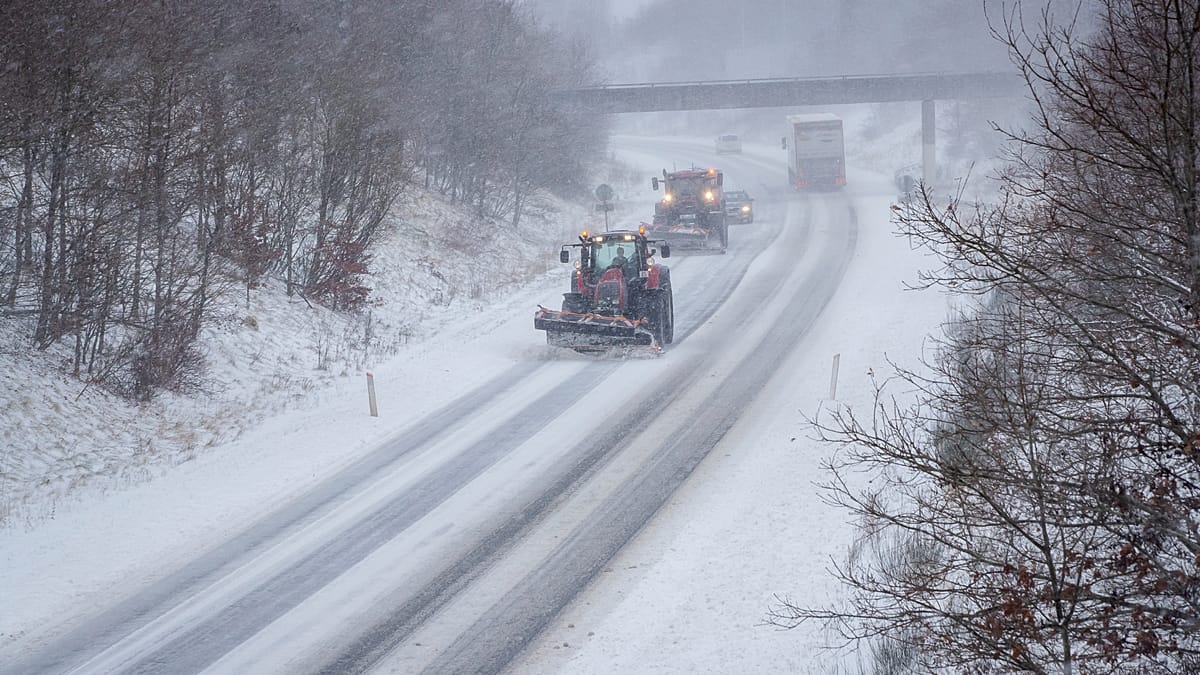
Euronews spoke to Patrick de Bellefeuille, a prominent Canadian weather presenter and climate specialist, on how Europe could benefit from Canada’s long experience with snowstorms. He has been forecasting for MétéoMédia, Canada’s top French-language weather network, since 1988.
Euronews: What are the main Canadian ‘best practices’ for dealing with heavy snowfall?
Patrick de Bellefeuille: Municipal authorities also prepare in advance. They know when snowstorms or freezing rains are coming. Regarding de-icers or abrasives used on streets and sidewalks, there are different types depending on the conditions. For example, if snow has fallen and temperatures drop below -15°C, sand and gravel are used. When temperatures are just below freezing, a salt-based abrasive that melts ice is applied. Authorities plan carefully and use preventive measures whenever possible.
Euronews: Right, but what we saw this week in Brussels and other cities is a snowstorm that caused huge disruptions, as if heavy snow was nearly unprecedented. Schools closed, traffic was chaotic, there were accidents, people slipped—it seemed like a lack of preparation.
Patrick de Bellefeuille: Here in Quebec, we have a law requiring winter tires from December 1 to March 15—it’s mandatory (…). That solves a big problem. We also have five “snow days” in our school system, when children don’t go to school if roads are unsafe. Decisions are based on road conditions: can children safely take school buses? If it’s too dangerous, a snow day is declared. At the end of the school year, if fewer than five snow days are used, school days are adjusted accordingly.
Euronews: What general advice would you give to Europeans to protect themselves from snowstorms? What do Canadians do?
Patrick de Bellefeuille: Even with 20 cm of snow, life goes on here—it’s normal. Our main concern is ice. I prepare by consulting forecasts and planning my day around weather conditions: when it will be worst and how to adapt. Consider public transport: buses have snow tires, which could also be done in Europe. Where winter tires aren’t mandatory, a plan B—like chains on buses—should be in place.
Not to nitpick, but Finland is in Europe and the Finns know everything there is to know about harsh winters. Euronews could have gotten good advice from within Europe too.
Yes indeed, you don’t even need to go to the Nordics, winter tires and gravel for low temperatures are a common knowledge in the Central Europe too. I guess this knowledge also exists locally in the most of European countries otherwise considered warm: Greece, Italy or Spain all have high mountains where this certainly applies. And even the UK has Scotland. About the only countries which might learn anything from this are Malta, Ireland and maybe Cyprus, but they probably don’t need to know anyway.
This article sounds like Euronews needed some fluff piece and happened to have some clueless journalist in Canada.
Suomi mainittu!
Was going to say pretty much the same. As someone who immigrated from a country that plays the “first snow traffic chaos ballet” every year. Here, the buses aren’t even a minute late. I hear the comforting sound of the snow plow scraping the streets most nights.
“Who?”
No, that’s a British band from the 60’s
Ffs, Euronews does know we have snowy winters in europe too, right?
Also no, this does not qualify as an “extreme” winter. This would’ve been a regular winter not 15 years ago. Extreme winter is one where you would be snow in april in Spain or something.
But we are obviously moronic Europeans, so how would we able to remember such complicated facts like “winter exists”.
PS: Euronews was bought by Alpac Capital, whose CEO is best buddy with Orban. So I would expect a similiar trajectory for their content quality like Politico or other “news” bought by right-wing populists.
Also no, this does not qualify as an “extreme” winter. This would’ve been a regular winter not 15 years ago. Extreme winter is one where you would be snow in april in Spain or something.
Or where the snow just builds up until every free space is filled with snow mountains. Actually that isn’t “extreme” either, that’s just a good winter.
Municipal authorities also prepare in advance … we have a law requiring winter tires …
What does this person think we are doing in Europe? We have weather forecasts, too, and winter tyres are mandatory in several countries, not only in the Nordics.
I am a complete layman in this field, so please correct me if I am mistaken, but this seems odd to me. That’s not to say Europe can’t learn from Canada in this and a lot of other areas, but the content is very weak imho.
Well, in Germany you are allowed to roll all weather tires all year round. And they’re shitty in snow, so there’s that.
AFAIK, you are even allowed to use summer tires during wintertime, just not during winter weather. Which leads to many people betting on good weather and keeping there summer tires
German laws appear to be a bit more relaxed than elsewhere. I found an overview for on mandatory winter tyres Europe.
For Germany, it says:
The German regulation doesn’t indicate a minimal temperature or a determined period when the vehicles shall be fitted with winter tyres. Drivers must adapt the tyres to the weather conditions. Winter tyres are mandatory in case of black ice, packed snow, slush, glaze and slippery frost.
I’m pretty sure Canada knows exactly the same things Scandinavian countries do.
I’m from Denmark, the warmest of the Scandinavian countries, and we’ve used grovel too when temperatures go below where salt has any effect, but we’ve also begun to use it because it’s more environmentally friendly.We just had 20cm snow in our 4th largest city, and of course life goes on, with very little disruption.
20 cm may have become rare now here, but it used to be way more common, and obviously in Sweden Norway and Finland it is way way more common than in Denmark.We also have regulation that if you drive when it’s snowing or icy, you must have winter or all season tires on your car.
But if you wait until the roads are cleared, you can still use summer tires. But again we are the warmest of the Scandinavian countries, and conditions here are not as extreme as in Canada, for that the other Scandinavian countries should just about cover it.It’s fine to share knowledge with Canada, we may be able to learn from each other, but there is nothing new in what was posted here. And I bet countries like Austria, Germany Switzerland and even Italy have similar experience with handling snow as we do in Scandinavia.
Europe is not like UK, where they put water pipes on the outside of houses to make them easier to repair when frost make them burst.
Honestly, why really care ? In France it was considered as a cold wave, but it was only the coldest days for 8 years because we only got winters warmer than the previous, and with a storm following, the snow lasted 3 days or so. I am really sad because I fucking love snow, I even went out to just feel it under my shoes, but investing in machines for 3 days in 8 years is a bit too much.
Fucking global warming
Heh, kinda funny that Euronews completely ignores the European Nordics and goes to Canada for advice. Oh well. Mistakes were made, I guess.