
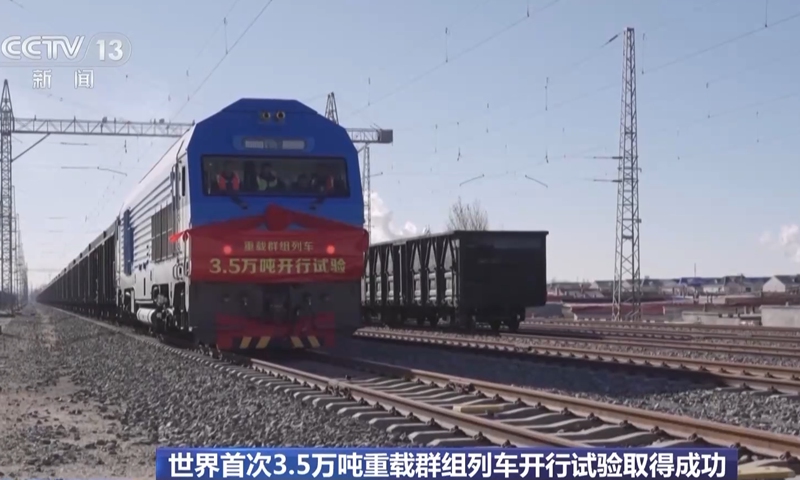
A Chinese industry analyst said that the success of this trial will fundamentally reshape the existing railway technology system and revolutionize global heavy-haul railway technology. The technology could be applied to high-speed rail, urban rail transit, and conventional railways, providing core technical support for China’s railway industry and driving the global advancement of heavy-haul train control systems toward greater efficiency, safety, and intelligence.
A major challenge of the test was to enable seven freight trains - each carrying 5,000 tons of freight - to connect with each other without mechanical coupling. Instead, the connecting process was completed using China’s independently developed intelligent control system, under which the seven trains achieved perfectly synchronized acceleration and braking throughout the journey guided by wireless signals, with no collisions or separations occurring, the CCTV report noted.
The 35,000-ton train consist represents the longest heavy-haul train group test in China, according to a report by the Science and Technology Daily on Monday. During the trial, seven separate train groups - located at the Nalingoumen, Shabazi, Guannianfang, and Dalad North stations in Inner Mongolia on the Baoshen Railway - were dynamically formed into a single “virtual train group” through wireless “virtual coupling.” The trains operated in close-tracking, fully synchronized mode and eventually traveled to the south yard of Wanshuiquan South Station, where they automatically decoupled and entered the station separately, the report noted.
In China, freight trains have traditionally operated as single units, and it is a very difficult mission to make seven “giant truck”-like trains run in coordinated formation on the same railway track without any physical connection while maintaining perfect synchronization.
Following the success of the test, China could increase its railway freight transport capacity by more than 50 percent without the need to construct new rail lines. It would offer the world a Chinese technological solution to address the challenge of enhancing heavy-haul railway transport efficiency, according to the CCTV report.
Can I just say as an engineer who’s career is in product safety, if my boss came to me and asked if we could build a heavy freight train but replace the mechanical links with absolutely nothing but hopes, prayers, and wifi. I would rather just shoot myself
no shame in admitting that Chinese engineers are superior
Oh yes. 50,000 tons moving at Mach fuck, attached to nothing. It’s a good thing technology never fails.
That’s right, absolutely impossible to come up with any safety measures aside from physically tethering train carts to each other.
Also not what I said. Cool interrogation bro
it’s pretty clear what you were insinuating here bro
That this is not a safe technology to employ in rail transport? I wasn’t IMPLYING that
Whether or not it is safe depends on how stringent the safety measures are. Even physical links can fail in extreme circumstances, or with poor maintenance or improper handling.
Let’s wait and see what the testing shows. Let them have a trial run of the technology and count how many accidents happen. For now we can’t make conclusions if we don’t have any data, right?