

Before delving into the topic, let’s be very clear about one thing: anarchism in most forms is communism, and vice-versa. There was not really a distinction when the socialist movement was born. Many anarchists consider themselves “anarcho-communists”, and many marxists are in fact libertarian and don’t defend a “dictatorship of the proletariat”. There is not really an opposition between anarchists and communists, but there is a strong historical opposition between free-thinkers and a marxist-leninist vanguard eliminating everyone who disagrees with it including many marxists. I’ll assume in the rest of this comment that’s what you meant with “relationship between anarchism and communism”.
From an anarchist perspective, i can attest to books others have recommended. Classic anarchist books give very good historical examples and arguments against the tyranny of a well-meaning vanguard ; i was lately reading Bakunin making that very argument about a scientist-run government, which i think is quite relevant today with Andreas Malm arguing for what we could call a green dictatorship of the proletariat.
More historically, [Bloodstained: one hundred years of leninist counterrevolution](Bloodstained: One Hundred Years of Leninist Counterrevolution) was a good read. So were some books about the Spanish revolution, but i don’t remember the names (except Homage to Catalonia, which someone mentioned). Emma Goldman, in Trotsky protests too much (1938) made a powerful historical account of how Trotsky and Lenin rewrote history after massacring the Kronstadt soviet, and i remember reading some french translation of Volin, a great revolutionary from the russian/ukrainian revolution (but i don’t remember which text precisely).
For a case where “anarchism” and “communism” work fine together, you can read about the zapatistas. I personally would say there’s two interesting features making it work:
- the zapatista movement refuses identification with marxism or anarchism, saying their political orientation has much deeper roots, from much before the europeans divided themselves along those lines
- the zapatistas have a strong separation of powers: the militias (which tend to be more marxist and hierarchic) don’t have any political powers because they have the military power, and leave 100% of the political power to the communes (which tend to be more anti-authoritarian farmers)
All in all, the zapatistas have elements of authoritarian culture (especially in the people’s army, where discipline and security management is important) and anti-authoritarian culture as they have no State, police or prisons as we know them. Unfortunately, apart from oral history recounted by comrades, i don’t know of good sources for these specific questions/divisions/perspectives.














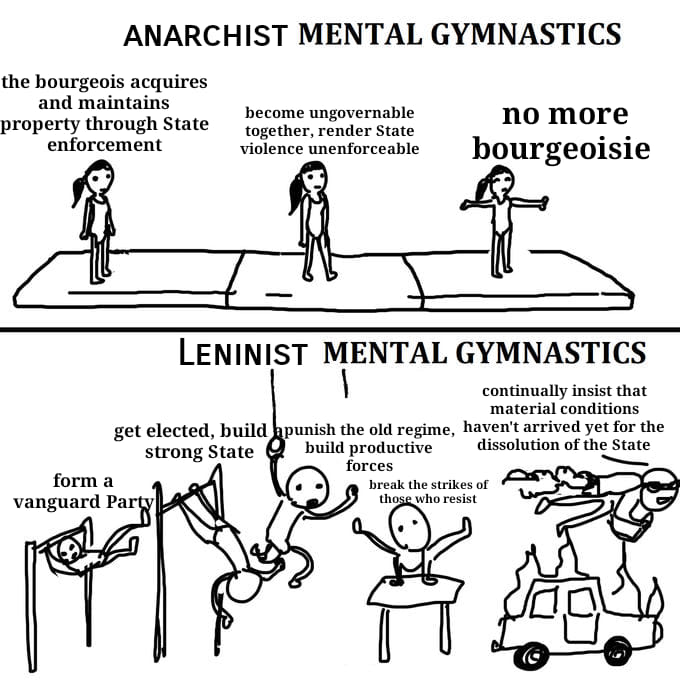


It’s hard to formulate a coherent opinion because reality is complex and multifaceted. And on the one hand, “purity” is an impossible goal in politics and can lead to various forms of sectarianism and moral judgement (as you can see in much of the liberal left who’s much more interested about optics and PR than about direct action and building collective power).
I mean, from some perspectives, calling China or USSR “socialist” is already picking a side. Neither really abolished private property, both have/had very wealthy ruling classes, and both came hard on the critiques from the left who were building popular power via the soviets (see Emma Goldman / Volin for early critique of bolsheviks killing communists and dismembering the soviets). In marxist views, the dictatorship of the proletariat is supposed to be the ugly/necessary phase on the road to communism (abolition of State and private property); a critique of those “socialist” States is that they are not working toward these goals but merely reinforcing themselves for their own sakes.
I mean, was the USSR good or evil? Both? Neither? From a geopolitical perspective (be careful with those analysis, the tools of the enemy usually produce the worst thoughts), the USSR provided balance to prevent total US domination. In a more local perspective, they supported many revolutionary movements throughout the world, but also destroyed some revolutionary movements around the world when it did not fit their interests (eg. Spain 1936). In the case of Ukraine/Russia 1917-1921, they crushed millions of people in the name of their so-called revolution and tried to bribe figures of the movement (such as Kropotkin, who died in poverty refusing privileges that were not given to the masses, or Emma Goldman, who at first fell for it before realizing). Later, under Stalin, they committed a bunch of actual genocides.
I personally don’t think we can say things are better or worse in China today than in the West. In some regards, they are much better (education/healthcare), and in some regards they’re much worth (pollution/slavery). A comparison can only be applied if very strongly situated (studying a specific aspect, from the perspective of a certain social group) otherwise it will be meaningless. There are strong social movements both in Europe and in China; as an anarchist, i believe my comrades are those who struggle all over the world, and my enemies are the States on both sides crushing the people.
Although i would object to saying the USSR was not imperialist, or that China isn’t imperialist today. From a very strict definition of Lenin they are not, but as i talked earlier about Ukraine/Chechnya, the USSR had colonial blood on its hands, a very clear process of “otherisation” and deprivation which is characteristic of colonialism. Just like today, it’s hard to look at military occupation in Tibet, the mosque destructions and muslim reeducation camps in Xinjiang, and not draw a parallel to (being a french person) French imperialism and colonial practice.
Nothing is binary and in communist/anarchist praxis, self-criticism is very important. While not exactly an anarchist/communist revolution, you may be interested to read about the Kurdish liberation movement and Rojava’s democratic confederalism. They practice tekmil weekly and that’s a very important part of life especially in the collectives / public administration. My personal rule of thumb is if a specific power/person is not capable to hear criticism from their left and below, they are not working in the interests of a global socialist revolution and in the interests of the peoples ; under that standard, both China and the USSR would fail the test.
Oh i forgot to link to a zapatista perspective about not being anarchist/communist.